Before worship begins, a chair is moved so that a wheelchair user can join the circle without being left at its edge. Large-print sheets are set beside the service books, and someone repairs a torn hanging instead of hiding it or buying a grander one. Each act helps the room tell the truth about the God whose welcome the church has come to receive.
Christian conversion receives the beauty of Jesus Christ, the crucified and risen one in whom the truth and love of God shine together. Grace gives us Christ. In him the world is given back to us as creation, other people become neighbors, and ordinary life can be received with gratitude instead of consumed as raw material for the self.
A melody can be beautiful through the shape of its phrases, and a room through its proportions and light. Such beauty gives pleasure in a form we can attend to. Moral goodness concerns how we act toward God and our neighbors, while Christ's glory reveals who God is through the Son's self-giving life. These are related without being interchangeable. A lovely room may conceal cruelty, and a faithful act may be awkward or painful. Yet a form can help us perceive what is good and learn to love it. The room prepared for worship begins to do this when its arrangement makes the welcome proclaimed there visible.
Union with Christ teaches us to desire and delight differently. Paintings, music, architecture, and ceremonial skill may serve that learning, though their cost or splendor can also distract a community from repentance. The church therefore receives beauty with gratitude while asking whether its forms help people attend to the truth they proclaim.
A World Given Back
Conversion turns our desires toward God. Augustine remembers hearing a childlike voice repeat the command to take up and read. He opened the apostle Paul, and the words he encountered brought his long struggle to a point of surrender.1 The voice mattered, as did the garden, the book, his friend nearby, and the physical act of reading. Still, Augustine did not describe a successful aesthetic technique. Scripture addressed him, and grace freed him to answer.
Years later, Augustine wrote with tenderness and caution about the senses. The beauty of created things asked him to seek their maker. Sacred song moved him to tears when what was sung entered his mind. Yet he worried that pleasure in the melody might carry him away from the words.2 His caution is not contempt for the body. It is the care of someone who knows that good things become disordered when we ask them to bear the weight of God.
This is why Christian formation includes the senses while refusing to manipulate them. Psalms, candles, architecture, and other arts may help people attend and respond to the church's proclamation. Their beauty has no independent power to produce faith. The stronger sacramental claim, that Christ gives what he promises through appointed signs, concerns his action and promise, not the aesthetic quality of a rite. The disagreements among Christians about that claim must remain visible.
Grace heals the possessive habits that govern how we look. This does not mean that blindness, deafness, disability, grief, or neurodivergence must be cured before someone can perceive beauty. The healing belongs first to our habits of self-protection. Grace teaches us to receive rather than seize, to notice without turning another life into an object, and to make room for forms of perception different from our own.
The Glory in a Human Face
Isaiah's servant has no impressive appearance that commands admiration. John's Gospel speaks of the hour of glory as Jesus moves toward the cross. Paul writes that the light of God shines in the face of Christ and that this treasure is carried in fragile bodies. These texts keep Christian beauty close to the mystery of a love that gives itself. In Christ, God's goodness becomes known through a particular human life. To call that life beautiful is to delight in the way his words, actions, and bodily presence disclose the love he gives. His glory supplies a measure for our delight, since what attracts us can also teach us to admire domination or indifference.
The risen Jesus still bears his wounds. Thomas is invited to encounter the body that was crucified, not a polished replacement. The church therefore cannot make unmarked strength, symmetry, youth, or visible success its measure of human glory. Paul's body of Christ requires special honor for members treated as weaker. Christian beauty learns to cherish bodies in their particularity and to hope for the renewal of creation without despising the lives God holds now.
This does not make suffering beautiful in itself. Violence should be stopped, wounds tended, and wrong named without ornament. The cross reveals the beauty of Christ's faithful love within suffering caused by human sin. It never gives the church permission to romanticize pain or ask the harmed person to remain where danger continues. A disclosure of abuse requires a prompt safeguarding response.
Delight still has its proper freedom when a hymn rises with unguarded joy or sunlight falls across a kitchen table without demanding moral explanation. Flowers may be placed on an altar simply because creation is good and praise seeks a fitting form.
Ordinary beauty can console a congregation before anyone knows what to say. A familiar psalm may carry the person whose own words have failed, just as the grain of a wooden rail, worn smooth by many hands, recalls that others have knelt here through fear and thanksgiving. Soup brought after a funeral can make care visible when sorrow has made the day shapeless. None of this resolves grief, but it gives grief a place among people who will pray, eat, wait, and remember together.
Such beauty is often received slowly. A child learning a hymn one phrase at a time may come to hear its promise through the melody before being able to explain it. Years later, the same words may speak differently in grief. The form has served by giving truth a place in memory, where it can accompany a life whose circumstances keep changing.
What Worship Gives the Senses
The Second Vatican Council says that Christ acts in the liturgy through sensible signs, meaning signs received through the senses. It also says that the church has never claimed one artistic style as its own and that sacred art may come from every people and region. Its preference is for noble beauty rather than sumptuous display.3 These judgments honor form while loosening the bond between holiness and expense.
Pope Francis later described the way of beauty as part of handing on the faith. He joined it to truth, goodness, the risen Christ, and the creation of new signs within many cultures.4 Beauty here is not ecclesiastical decoration applied after the real theology is finished. It is one way truth enters memory, desire, gesture, and shared life.
Baptist and Quaker witnesses bring distinct gifts to this question. The Southern Baptist confession places the local congregation under Christ through Scripture and describes baptism and the Lord's Supper as ordinances of obedience.5 In that account, bodily and communal signs proclaim Christ's death and resurrection without being treated as sacramental causes of grace. This gives a congregation a practical question for its art and worship. Do these forms proclaim Christ and summon faithful response, or have they become ends in themselves?
Robert Barclay's Quaker defense makes a stronger claim. He warns against outward observances performed by natural strength rather than by the Spirit and refuses to treat the mere continuation of a form as true worship.6 This expectant dependence on the Spirit is a gift to the whole church. It also marks a real disagreement. Sacramental Christians confess that God addresses embodied creatures through the proclaimed word and through material signs Christ commands and the church receives for worship. Christians disagree about which signs bear a promise and how they do so. No form possesses an independent power to cause faith.
Paul says that faith comes through hearing the word of Christ and that faith rests on God's power rather than human eloquence. This gives Christian beauty its humility. A choir may sing with discipline, a preacher may speak with clarity, and a table may be set with care. The grace announced in these forms still arrives as God's action. A congregation with few resources is not spiritually inferior to one with historic stone, trained musicians, and inherited silver.
Who Can Enter
Every material form has a social history. Someone cleans the floor, cooks the meal, repairs the roof, rehearses the music, or pays the bill. A beautiful common life honors that labor, pays for it fairly, and notices when its forms prevent a neighbor from entering or speaking safely.
The question reaches beyond individual buildings. Indigenous Christians gathered before the World Council of Churches assembly in 2022 described the spiritual violence of churches that demanded cultural conformity and helped dissolve relationships among language, land, memory, and identity. They also confessed that they recognized the Creator's voice in the teaching of Jesus and did not hear a command to reject who they were.7 The church's catholic life grows as people praise Christ in the languages and forms through which they have learned to know creation. When churches receive art, language, and wisdom they once suppressed, their common life may be corrected and enlarged.
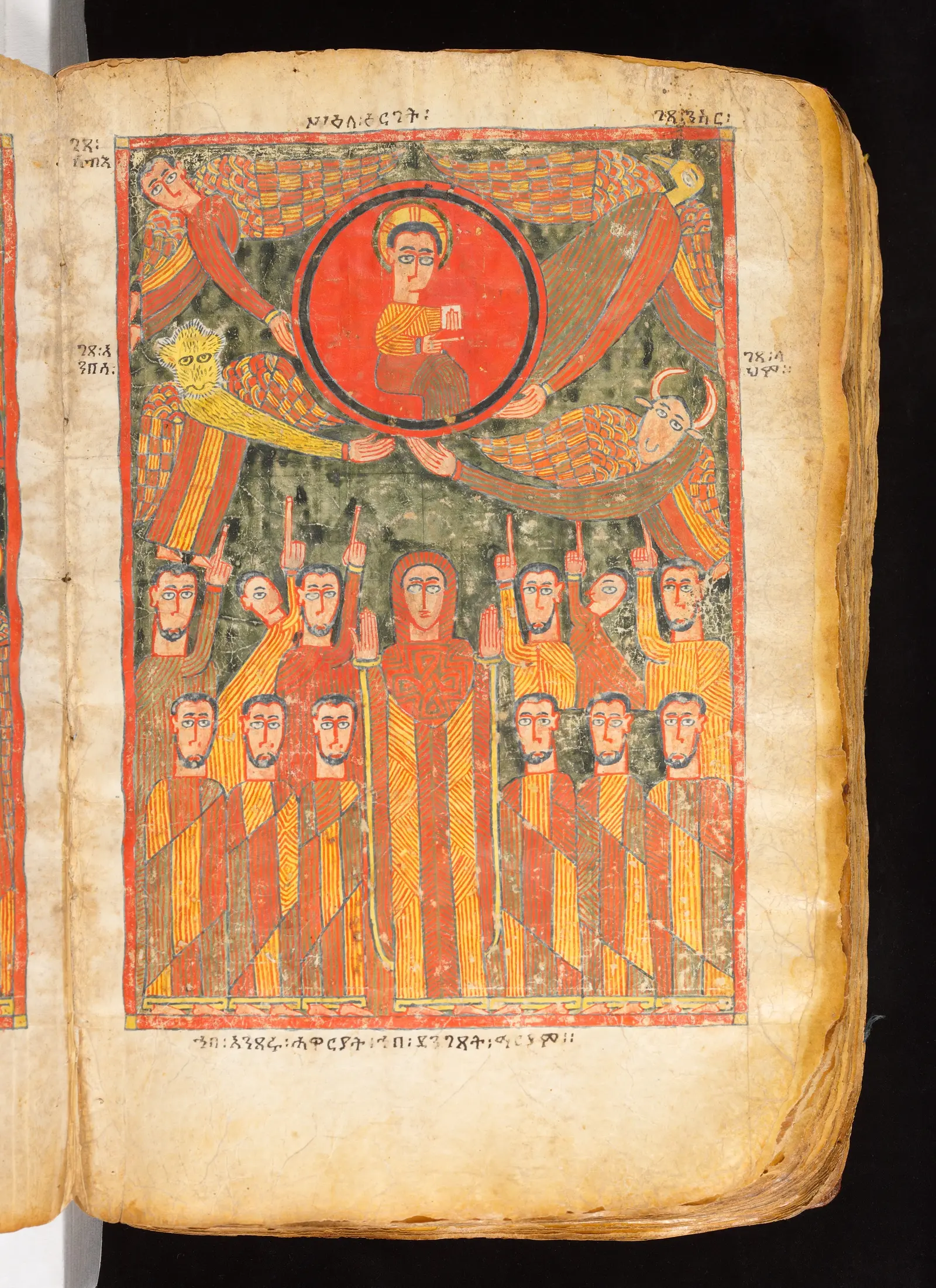
A late medieval Ethiopian Gospel book offers another history. Made at a northern Ethiopian monastic center, it joins Geʽez Scripture to a painted cycle shaped by Byzantine prototypes and transformed into a local Christian idiom. Its images were encountered within the liturgical life of the Ethiopian Orthodox Church.8 The Ascension leaf is vivid and worn. Christ is held within a red circle above Mary and the apostles, while paint, parchment, writing, and the marks of use remain together.
The page belongs to its own Ethiopian Christian history, not to a simple tale of cultural harmony. The journal draws from it a constructive proposal. Catholic faith can take material form without aesthetic sameness, and local Christian artistry can belong fully to the church's common praise.
The chair moved before worship belongs within this argument. Its place changes both the room's arrangement and the relation of those gathered there. Access is a requirement of neighbor-love whether or not anyone finds the result attractive. When the arrangement also lets a person take an unembarrassed place among others, the room gives that love a perceptible form.
Beauty After Brightness
Much of life is lived after brightness fades, when prayer grows dry, a beloved building closes, music once loved becomes difficult to hear, or grief changes the texture of familiar days. The Christian answer is the promise that creation remains held by the God whose love is faithful when our powers of perception are tired.
Julian of Norwich once held something as small as a hazelnut in her hand and understood it as all that is made. It seemed so little that she wondered how it could last, and her answer was that it endures because God loves it.9 Beauty appears here without grandeur in the creature that is made, loved, and kept.
The worn Gospel page can be received in this spirit. Its color and pattern reward attention, while its marks of use recall a life of prayer beyond our own. We can delight in it without possessing the history it carries. The same freedom allows sunlight on a kitchen table to be enjoyed without making it prove that the day is good.
Christian conversion needs beauty in this sense. Christ draws our love toward the God whose goodness he reveals, and frees us to delight in creation without grasping at it. Aesthetic pleasure will sometimes accompany that freedom and sometimes fail us. The crucified and risen one remains its source, teaching us to receive a world whose goodness exceeds what we can presently see.