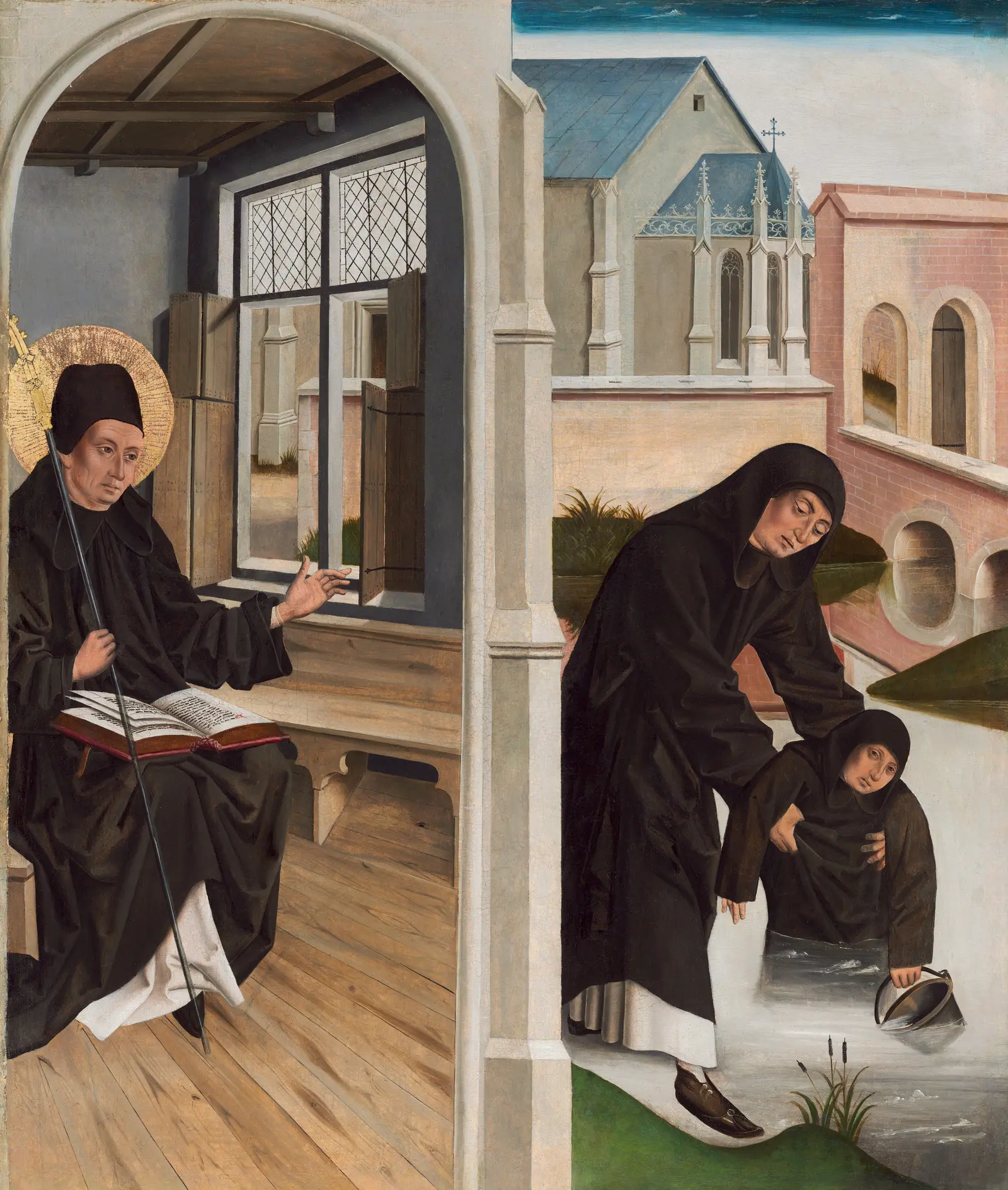
Someone unlocks the parish church while the street is still quiet. Another person switches on a lamp and sets out two service books. A third arrives late from an overnight shift and slips into a chair as the opening sentence is read. They say a psalm, hear Scripture, and place the coming day before God. Their return to prayer carries a Christian memory older than Anglicanism.
Christians had prayed at appointed hours, read Scripture in common, shared goods, served the poor, and sought ordered forms of discipleship long before Benedict wrote his Rule in sixth-century Italy. He gathered such practices into what he called a school for the Lord's service. He expected divine help at the beginning, patience along the way, and growth into the love that casts out fear. Discipline gives that dependence a daily form. At the end of the Rule, Benedict called it only a beginning and pointed his readers toward Scripture, the fathers, and Basil.1
Anglicanism received its Benedictine inheritance through a history of rupture, reform, and deliberate recovery. The suppression of the English monasteries dispersed their communities, while the Prayer Book carried elements of the Western daily office into vernacular worship. Centuries later, Anglican religious communities explicitly adopted Benedict's Rule again. Any truthful account must therefore distinguish practices carried through the Reformation from practices reclaimed afterward.
A Life Given an Order
The Rule gives the whole day an order that includes prayer, sacred reading, meals, service, and rest. The hours of prayer interrupt labor and sleep because Benedict says that nothing is to be preferred to the Work of God.2 Prayer thereby enters the community's practical responsibilities and teaches its members what every hour is for.
That ordering reaches the kitchen and the storeroom. The cellarer is told to regard the community's goods with care. Kitchen service is shared. The sick are to be served as Christ, and those with less strength are given work suited to them. Benedict's pattern refuses to separate spiritual aspiration from food, tools, fatigue, and the needs of a body.3
His famous chapter on guests is equally material. The guest is welcomed with prayer, a meal, a place to sleep, and the labor of a kitchen assigned to the task. Special attention belongs to poor people and pilgrims because Christ is especially met in them.4 Hospitality becomes visible in rooms, workers, provisions, discernment, and limits that allow strangers and residents to live safely together.
Stability gives this life its local weight. A monk promises to remain with particular people instead of forever seeking a community arranged around personal preference. Such staying can train patience and make repair possible. It can also be corrupted. The Rule gives great authority to the abbot and includes punishments and restrictions that should not be transferred into parish life. It also tells the abbot to summon the whole community for counsel and allows a brother to explain calmly when a command is beyond his strength.5
Christian stability never requires someone to remain under abuse. The Church of England's present guidance for religious communities calls for cultures open to challenge, power that is not concentrated in one person, safe boundaries, and relationships beyond the community.6 Leaving danger, reporting harm, and refusing concealment are faithful acts. Christian authority answers to Christ as witnessed in Scripture. It remains subject to external oversight, respects conscience, practices communal discernment, and is judged by its care for the vulnerable neighbor.
What England Broke and Carried
Benedictine observance became a major force in English monastic reform from the middle of the tenth century. Its history was never uniform. Monasteries could be places of worship, learning, hospitality, landholding, patronage, privilege, and conflict at once. Saint Augustine's Abbey in Canterbury offers one concrete history. It became an important center of Benedictine reform, and by the sixteenth century it possessed shrines, books, buildings, estates, and extensive local power.7
Between 1536 and 1540 the English crown dissolved the monasteries and took control of their property.8 Saint Augustine's surrendered on 30 July 1538. Its abbot and thirty monks received pensions, some monks later served in parishes, its library was dispersed, shrines and tombs were destroyed, and part of the precinct became a royal palace. Demolition of the church was ordered in 1541.9 The record holds destruction and selective reuse together. It does not permit either a tale of painless reform or an imagined medieval innocence.
The Prayer Book belongs to this altered world. Its preface, Concerning the Service of the Church, appeals to the ancient ordering of Scripture and psalmody while criticizing services in which biblical reading had been interrupted, rules had multiplied, and worship remained inaccessible to people who did not know Latin. Morning and Evening Prayer formed a simpler English order for daily use.10
An older Anglican account described Morning Prayer as drawing from the night office, Lauds, and Prime, and Evening Prayer from Vespers and Compline.11 Morning and Evening Prayer carry a compact daily pattern shaped by older Western hours and reformed through Protestant judgment. The psalms, canticles, lessons, and collects carried memory forward in a changed ecclesial body.
Religious Life Returns
Anglican religious life returned in the nineteenth century through deliberate experiments in community. Women were central from the beginning. The Community of St Mary the Virgin was founded at Wantage in 1848, where sisters combined prayer with nursing, education, and care for people in need.12 Their life did not continue an English monastery secretly preserved since the Reformation. It marked a new foundation amid changing politics, renewed interest in the early church and the Middle Ages, and the practical needs of industrial society.13
Petà Dunstan's history of Anglican religious identity names both the strength and the risk of this revival. Gothic architecture, personal rule, and social usefulness could help communities establish a public vocation, but they could also become substitutes for a deeper account of life in Christ.13 The communities had to ask what their discipline was for, a question every generation must ask again.
Later communities made explicitly Benedictine choices. The community now at Mucknell Abbey was founded in 1941 and gradually adopted Benedictine observance, making its first solemn professions under the Rule in 1952.14 At Malling, an Anglican Benedictine community came in 1916 to the site of a medieval nunnery surrendered in 1538.15 The place joins two communities across a long break. It is a sign of retrieval rather than proof that nothing had ended.
These renewals belong beside continuing Roman Catholic and Orthodox monastic life. The Second Vatican Council describes religious life as a living charism ordered under Christ and Scripture, renewed through prayer, common life, and attention to the needs of the church.16 Eastern common life has its own sources and continuity. Basil describes shared life through the gifts people offer one another, the service they need, and the correction that solitude cannot provide.17 Anglican retrieval did not restore monastic Christianity to the church. It entered an ascetical tradition that had continued beyond Anglican life, and the particular vocation of vowed communities cannot be reduced to a set of useful parish habits.
These communities also stand under Protestant questions. The Augsburg Confession protests vows imposed without freedom, monastic observance treated as a way to earn forgiveness, and the idea that vowed life is a higher Christian calling than family, work, and civic responsibility.18 Discipline can train people who already depend upon mercy; it cannot justify its keepers or make God indebted to them.
A free-church Christian may press the question further. Why should a congregation seek a monastic ancestry for practices already commanded in Scripture? A free-church answer can point to covenant, Bible reading, testimony, mutual aid, and accountable service as forms of disciplined common life. Benedict's usefulness lies in the patient arrangement of time, possessions, authority, work, and care. His Rule is one tested school within the church, while the Spirit also forms communities that do not claim this pedigree.
The Parish at Its Next Hour
A parish that learns from Benedict can begin modestly. It may keep one dependable time of common prayer and choose that hour with caregivers and shift workers in mind. Someone who cannot attend can be given the readings and invited to send a petition. Scripture and prayer then become the congregation's work rather than a performance supplied by clergy.
The same discipline can bring hidden labor into view. After prayer, one person washes the cups while another stacks chairs and checks the accessible entrance. Sharing this work gives the congregation a chance to notice who usually stays behind and whether service is fairly supported. Questions about who controls money and property, who enjoys security, and who works without recognition belong within the spiritual life.
Keeping that hour dependable also requires judgment about its limits. If the person who usually unlocks the church becomes ill, someone else must know where the key is and how to prepare the books. A shared order can carry the gathering through one person's absence without making that person feel guilty for resting. Over time, such ordinary arrangements allow prayer to become a durable part of the neighborhood's life.
Soon the small parish company will close its books. One person will go to work, another will return home to sleep, and someone will stay to prepare the room for the next gathering. The parish has not become a monastery. It has allowed prayer to give an hour its shape, and that hour may help the next one become more patient, more responsible, and more available to God and neighbor. When they return, the same books will be waiting, and the life between those prayers will have become part of what they bring before God.