The church in Corinth had bread, a cup, and a gathering called in the name of Jesus. It also had factions in which some ate and drank to excess while others went hungry and were humiliated because they had little. Paul looks at this assembly and tells them that when they come together, it is not really the Lord's Supper they eat.
His judgment is severe because the meal is holy. Paul brings the congregation's conduct under the meaning of the meal itself. The self-giving love of Christ places their common life under judgment when some feast while others go hungry.
The people who approach the Lord's table rarely arrive inwardly composed. Grief can make familiar prayers difficult to follow, while caregiving, work, illness, or a sleepless night can leave the body tired and the mind wandering as the liturgy continues. Paul's rebuke widens the question of readiness from private composure to responsibility for hungry and humiliated neighbors. Christians come as receivers. Christ gives himself to people whose attention, strength, and fellowship remain unfinished.
The Communion Christ Gives
In the previous chapter of First Corinthians, Paul calls the cup a participation in the blood of Christ and the bread a participation in his body. Because there is one bread, the many are one body. The movement begins with what Christ gives. On the night he was betrayed, the Lord took bread and placed his death at the center of the church's life. Worshippers bring the truth of their condition to a gift they did not create.
The World Council of Churches begins its ecumenical account of the Eucharist with this prior action. The church receives the meal from the Lord as thanksgiving to the Father, remembrance of Christ, invocation of the Spirit, communion of the faithful, and a meal of the kingdom. That document records important convergence without pretending that the churches have resolved every disagreement about presence, sacrifice, ministry, or authority.1
Communion includes participation in Christ by the Spirit, the obligations Christians bear within a congregation, and visible fellowship among churches able to recognize one another at the same meal. These dimensions belong together, although each raises a distinct question about what Christians receive and what their reception publicly expresses. For churches that understand reception as the expression of already-shared ecclesial communion, love can cross a boundary while shared reception waits upon visible unity.
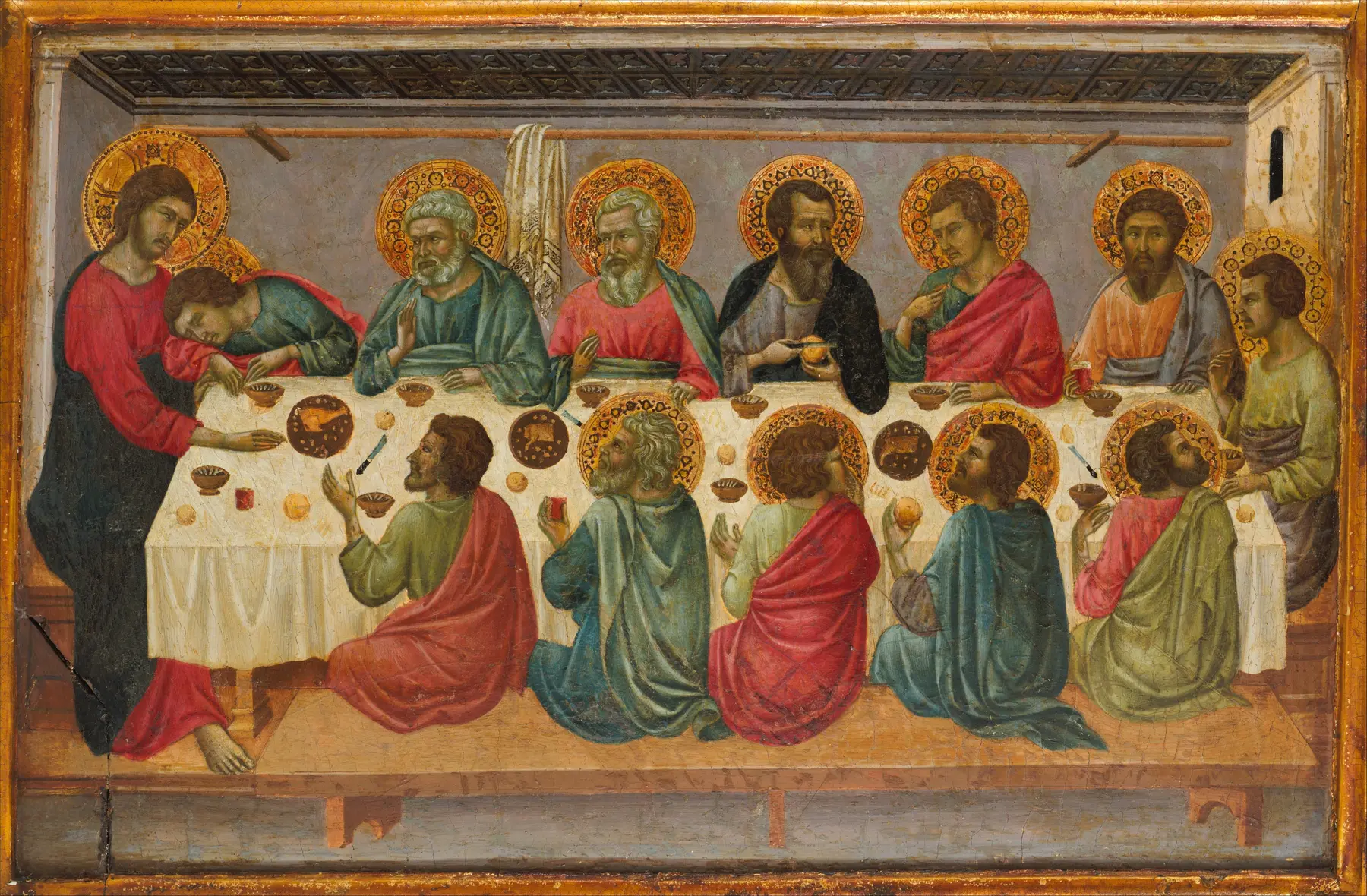
Ugolino da Siena's The Last Supper gives this tension a human shape. Christ sits at the far left and announces betrayal. The disciples turn toward one another, and Judas remains beside Christ without a halo. Betrayal remains inside the gathered meal, where Christ's giving and human failure occupy the same scene.2
Difference and Broken Fellowship
The one body contains real difference. In First Corinthians 12, the Spirit gives distinct members and gifts. The eye does not become a hand, and the stronger member does not absorb the weaker. Christian unity allows histories, callings, judgments, and cultures to remain particular. It asks whether those differences can be offered for the good of the whole.
Fragmentation begins when difference becomes humiliation, domination, abandonment, or falsehood. It also appears when Christians can no longer receive together without making contradictory claims about Christ, the gospel, the meal, or the church that celebrates it. Separation may then protect conscience, confession, or vulnerable people. It may also preserve an inherited breach that present Christians did not choose, or deepen into sinful schism. Calling all of these separations mere misunderstanding would avoid the truths communion requires us to face.
Early Christian witnesses speak of gathering and boundary together. The Didache prays that scattered grain may become one loaf and that the church may be gathered into God's kingdom. It also restricts participation to the baptized. Ignatius of Antioch joins one Eucharist to common confession, ministry, and order while arguing against schism. These texts come from particular communities and leave later controversies unsettled. They present the meal as participation in a confessed and ordered common life.34
The historic Prayer Book rite holds repentance, charity toward neighbors, reception of Christ, and continuation in holy fellowship within one act. Its disciplinary language belongs to another legal and pastoral setting, yet its sequence remains instructive. Christians prepare for the meal by telling the truth about sin, seeking peace where possible, hearing Christ's promises, and offering themselves to his service.5
Preparation gathers a scattered life around those promises. It does not require a worshipper to produce flawless concentration or a consoling religious feeling. Grief may remain grief, and fatigue may still be felt in the body. The liturgy lends words to the person whose own prayer has become thin and carries that person toward a gift received with the church.
What Receiving Says
Churches disagree about what Christ gives in the meal and about what a person declares by receiving. Roman Catholic teaching says that Eucharistic communion deepens incorporation into Christ and strengthens the unity of his body. It grieves the divisions that prevent common reception and treats admission across church boundaries within carefully defined limits. Orthodox catechesis likewise connects reception with the faith, discipline, and corporate responsibility of the church. In these accounts, receiving across church boundaries ordinarily expresses a communion already shared rather than serving as an experiment for producing it.67
The Lutheran confession says that Christ's body and blood are truly present and distributed. The Westminster Confession describes faithful communicants receiving spiritual nourishment and communion with the crucified and risen Christ through the Spirit. These traditions disagree about presence, yet both confess that reception concerns Christ's action and promise.89
The Southern Baptist Convention speaks of the Supper as symbolic obedience, memorial, and anticipation within the life of a covenant congregation. Remembrance here is public and embodied. John Wesley urged constant communion as Christ's command and as a mercy through which God strengthens love and holy obedience. He also addressed Christians who lacked time for extended preparation or felt no immediate benefit, directing them toward repentance, faith, charity, and trust in a strengthening that may be received before it is felt. These traditions give different accounts of how Christ acts in the meal, yet each locates Christian belonging within a gathered people.1011
Christians experience the divided table as a particular grief. Friends may pray and serve together while conscience, doctrine, or church discipline keeps them from receiving together. Common service, theological dialogue, repentance for inherited caricature, and patient friendship allow that grief to remain shared. They keep separation from becoming normal while the churches continue the harder work that contradictory doctrine and unhealed injury require.
Receiving in a Real Congregation
A crowded movement may overwhelm someone with sensory needs, and a rail reached only by steps can turn the invitation to receive into an obstacle. Eucharistic discipline is administered by actual people in such rooms. A church should announce its practice before the moment of reception, explain it without embarrassment, apply it consistently, and offer a private conversation when questions remain. Those who will not receive need a dignified practice that does not turn conscience, denominational history, disability, or uncertainty into a public interrogation.
Access belongs to the church's theology of communion because the arrangements reveal which bodies the congregation imagined. Quiet preparation may include readable instructions, a named person who can answer questions, and carrying the elements to someone who cannot reach the rail. No single provision answers every medical or pastoral need. A minister who asks, listens, and plans can keep a worshipper from negotiating conscience or access while the room watches.
Paul's rebuke reaches the ordinary church meal as well. The congregation can ask who buys the food, who cooks, who eats first, who cleans after others leave, and who cannot attend because of work, caregiving, transport, fatigue, or cost. A small church has finite gifts, and volunteers need freedom from invisible labor. Sharing the work, naming costs, offering assistance without shame, and noticing absence without surveillance are ways of learning the apostle's command to wait for one another.
Waiting for one another also protects people for whom proximity is unsafe. A common table serves Christ's peace only when truth and justice govern the room.
Repair Without Compulsory Proximity
The language of reconciliation can become dangerous when it asks an injured person to prove forgiveness by returning to an unsafe room. No Christian is required to touch, eat with, resume trust in, withdraw a report against, or remain under the authority of an abuser. Forgiveness, reconciliation, restored trust, renewed access, reinstatement to office, and institutional reunion are related questions, but they are not the same act.
Where grave harm has occurred, truth may require external investigation, civil reporting, restitution, changed leadership, and permanent boundaries. The person harmed should not be made responsible for displaying the church's unity. Sometimes distance protects the possibility of justice. Sometimes a congregation can share prayer and responsibility while personal contact remains impossible. The Supper announces Christ's peace, but it does not authorize the church to call an unsafe peace complete.
Carried Until He Comes
People may leave the table still grieving, tired from caregiving, or able to remember only a phrase of Scripture, the feel of bread in the hand, or the name of Christ spoken over the cup. The church's prayer carries them before they have mastered their inner life. Communion joins unfinished lives to the Lord's death and to neighbors whose needs place a claim upon the whole body.
Paul says that whenever Christians eat the bread and drink the cup, they proclaim the Lord's death until he comes. Christ's future is promised while fellowship remains contradicted by hunger, estrangement, injustice, and divided confession. Hope therefore sends a congregation back to the humiliations it must name, the repair it must begin, and the absences it has finally learned to see. Communion after fragmentation rests under the mercy of the Lord who gives himself and will finish what his church cannot finish alone.