Suppose someone remains after worship to ask about baptism. Two ministers have used the same words at the font while giving different accounts of what God does there. The person wants to know what this church believes before seeking baptism within it. A truthful answer should explain the promise being made and why the congregation can be trusted to teach it.
The congregation has already begun to answer by reading Scripture aloud and naming the Father, the Son, and the Holy Spirit in the Nicene Creed. It has confessed sin, heard pardon, prayed for the world, and received bread and wine. These actions give the church public words and visible commitments, though they also require teaching and honest practice. People can say a creed without understanding it, and institutions can contradict at noon what they confessed in the morning.
A broad church holds distinct schools of Christian conviction within a common life. Anglican parishes may bring evangelical preaching into conversation with sacramental devotion, charismatic expectancy, and critical inquiry. Each can expose something the others neglect, though none names a uniform party. Their differences become fruitful only when people can explain what they affirm together and where they disagree. Breadth becomes a discipline of communion when the church receives a common confession and remains answerable to it.
A Faith the Church Receives
Confession has two meanings in Christian worship as the church acknowledges its sins and professes its faith. These movements belong together because Christians name the God who made and redeemed them, then admit how poorly their common life answers to that truth. Confession offers conviction without institutional innocence.
The Church of England's Declaration of Assent gives this pattern unusual clarity. It says that the church belongs to the one holy catholic and apostolic Church, professes the faith uniquely revealed in Scripture and set forth in the catholic creeds, and is called to proclaim that faith afresh in each generation.2 The faith is received, yet its proclamation is living work. New questions cannot be met by pretending that history stopped when a formulary was written. Fresh proclamation remains accountable to the faith it seeks to make understood.
The center is Jesus Christ crucified and risen, the eternal Son of the Father who sends the Spirit and gathers a people. Scripture bears authoritative witness to this gospel, and the creeds give the church a shared grammar for confessing it. As baptism joins persons to Christ and his people and the Lord's Supper nourishes communion in him, Christians learn repentance, holiness, mercy, justice, and mission as forms of life under his lordship.
This recognizably Anglican account draws upon gifts received from the wider church. No Anglican formula should be treated as a neutral ecumenical definition. Christians disagree about the relation of Scripture, tradition, and teaching authority. They also disagree about the meaning and efficacy of baptism and the Supper, who may preside, and what participation says about ecclesial communion. A broad church becomes evasive when shared vocabulary is used to hide incompatible meanings.
These Church of England formularies leave no room for self-congratulation. Articles XIX through XXI describe a visible church gathered around faithful people, the pure preaching of God's Word, and the due administration of the sacraments. They also say that churches and councils may err, and that ecclesial authority cannot make God's Word contradict itself.3 The church speaks with authority while remaining capable of repentance.
What Clearer Confessions Teach
Broad churches sometimes speak as though detailed confessions belong to less generous Christians. That judgment is both unfair and unwise. A clear confession can protect a congregation from the preferences of whoever presently holds office. It tells ministers what they are entrusted to teach and gives ordinary members words with which to question them.
The Augsburg Confession offers a demanding account of unity. Article VII says that the church is where the gospel is rightly taught and the sacraments rightly administered. Agreement about the doctrine of the gospel and the administration of the sacraments is necessary for true unity, while human rites need not be identical everywhere.4 This is no endorsement of vague comprehensiveness.
The Lutheran challenge reaches directly into the baptismal conversation with which we began. The ministers must first establish whether they are expressing different emphases within a shared teaching or making incompatible claims about what God gives at the font. Repeating the rite cannot settle that question. Patience allows time to examine the disagreement, while the person seeking baptism is owed an intelligible account of the church's promise.
Free-church Christians add another needed correction. The Southern Baptist Baptist Faith and Message describes the church as a congregation governed by Christ through Scripture and baptism and the Lord's Supper as ordinances of obedience.7 Congregational covenant and discipline give members concrete ways to test fidelity to Christ without inherited liturgy or bishops.
John Wesley's sermon Catholic Spirit adds that love across Christian difference does not require indifference to doctrine, worship, or the congregation to which one belongs. A person may hold settled convictions and still enlarge the heart toward Christians who differ.9 Clear teaching can therefore help people identify both the faith they share and the judgments they dispute.
When Difference Becomes Contradiction
No formula can sort every dispute in advance. One useful working distinction begins with the faith confessed in baptism and creed. Clergy cannot deny the Triune God, the incarnation, the bodily resurrection, or Christ's lordship while speaking honestly in the church's name.
Other judgments govern teaching, ministry, discipline, and moral life. They may bind clergy while remaining open to reconsideration through the church's appointed processes. At the font, the ministers would need to set their explanations beside the baptismal rite, the church's received teaching, and the scriptural passages to which each appeals. A difference in imagery may leave the same promise intact. A claim that contradicts what the rite declares requires a judgment about teaching, however warmly the ministers regard one another. Ceremonies and local customs allow greater variation, but their place must also be explained.
The difficult work lies in deciding where a question belongs. The Lutheran Formula of Concord argues that ceremonies ordinarily free in themselves cease to be harmless when authorities impose them in a time of confession or use them to suggest agreement with false teaching.8 A moral judgment may be described as secondary while its consequences fall heavily upon a vulnerable neighbor. A governing body may follow every proper procedure and still exceed its commission by binding consciences where Christ has not bound them.
The parish cannot leave the person seeking baptism to arbitrate between its ministers. Those entrusted with oversight should hear both accounts, explain the scriptural and doctrinal grounds of their judgment, and make clear what will now be taught. The person affected must be able to ask questions and know where a complaint or appeal can be heard beyond the immediate dispute. If a minister rejects a standard publicly promised, consequences should be proportionate and reviewable. Punitive action intended to silence testimony, obstruct an appeal, or threaten unrelated pastoral care violates that accountability.
The Reformed tradition sharpens the limit. The Westminster Confession says that God alone is Lord of the conscience and that synods and councils may err. It also entrusts church officers with the keys of the kingdom and gives synods authority to decide controversies, order worship and government, and receive complaints when their judgments remain consonant with Scripture.11 A church may order its common life, but careful procedure cannot turn a human judgment into divine law. Reformed liberty of conscience limits ministerial authority without dissolving it because Christ has not surrendered his lordship to the institution.
Vatican II's decree on ecumenism joins firmness to humility. It warns against a false peace that clouds doctrine, while requiring truth, charity, and humility in explaining faith. Its hierarchy of truths orders doctrines according to their relation to the foundation of Christian faith. It does not declare some revealed truth disposable.5 The same decree calls the Catholic household to honest self-examination and continual reform. A confession becomes credible when it judges the church that speaks it.
Belief in Parish Practice
The baptismal conversation should end with a clear account of the life into which this person is being received, including any disagreement the church has judged it can bear. That account then has to govern catechesis and preaching. Otherwise the formal decision leaves the original confusion untouched, and the preferences of whichever minister speaks next become the parish's effective doctrine.
A doctrinal standard must also be able to expose harm sanctioned by the church itself. The Confession of Belhar arose from the Dutch Reformed Mission Church's struggle against apartheid in South Africa. Drafted in 1982 and adopted in 1986, it joins visible unity, reconciliation, and justice, and rejects enforced racial separation as a denial of the gospel's reconciling work.10 Abuse, concealment, exclusion, and retaliation injure people and corrupt the church's witness. Unity cannot require the harmed person to resume a relationship, surrender an independent complaint, or remain in an unsafe congregation. A faithful response may require removal from office, restitution, public correction, or separation.
The World Council of Churches describes legitimate diversity as a gift and also admits that churches still lack commonly recognized criteria and structures for distinguishing enriching difference from church-dividing difference.6 That unfinished ecumenical judgment should make a broad church patient without making it passive. It should also make the church cautious about presenting its own institutional survival as the visible unity for which Christ prayed.
Some disagreements do become breaches of communion. Christians may reach judgments they cannot reconcile while remaining truthful. Separation can then be an act of tragic faithfulness, though never an occasion for caricature or triumph. Separation does not erase the obligation to describe the other church truthfully.
Many Gathered by One Spirit
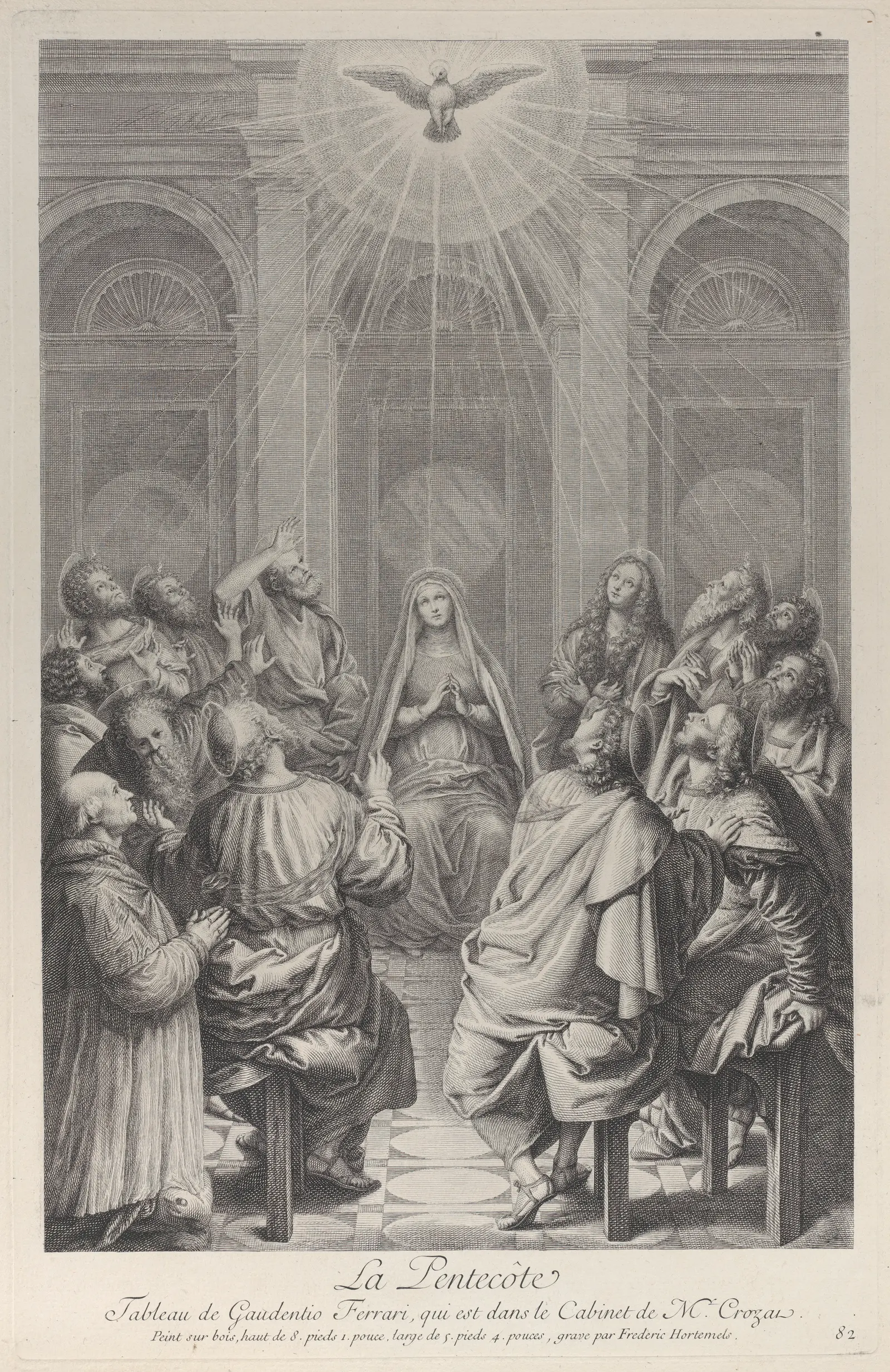
Frédéric Horthemels's eighteenth-century print of Pentecost gathers the apostles and the Virgin in a circle beneath the descending Spirit. A donor kneels at the left edge, near the apostolic company but not confused with it. Faces turn in different directions as rays cross the architecture and converge upon the gathered people.1
At Pentecost, the Spirit forms witnesses to one Lord and sends them into many languages. Their common witness begins in what they receive together. A broad church depends upon this same gift, and each party within it must be willing to hear Scripture address its own failures. Common prayer brings that need for correction before God as the congregation confesses both its faith and its sins.
Under the Mercy of Christ
Return to the person asking about baptism. The church believes in the Father who made heaven and earth, in Jesus Christ who was crucified and raised for the life of the world, and in the Holy Spirit who gathers and sanctifies a people. That faith takes public form as the church receives Scripture, confesses the creeds, baptizes, breaks bread, announces forgiveness, and seeks a life of holiness and love.
The two ministers need not become indistinguishable for this answer to be honest. They must be able to teach the church's baptismal promise without contradicting it, and to name the questions on which disagreement remains permissible. The newcomer can then judge what is being asked and receive baptism without having to guess which account the church will stand behind.
A broad church still believes when its welcome takes shape within the life Christ gives. Whether a particular disagreement can still be borne together may remain a painful question. Even there, Christians stand before the Lord whose name they share, asking for courage to speak truth and for mercy to keep them as his people.