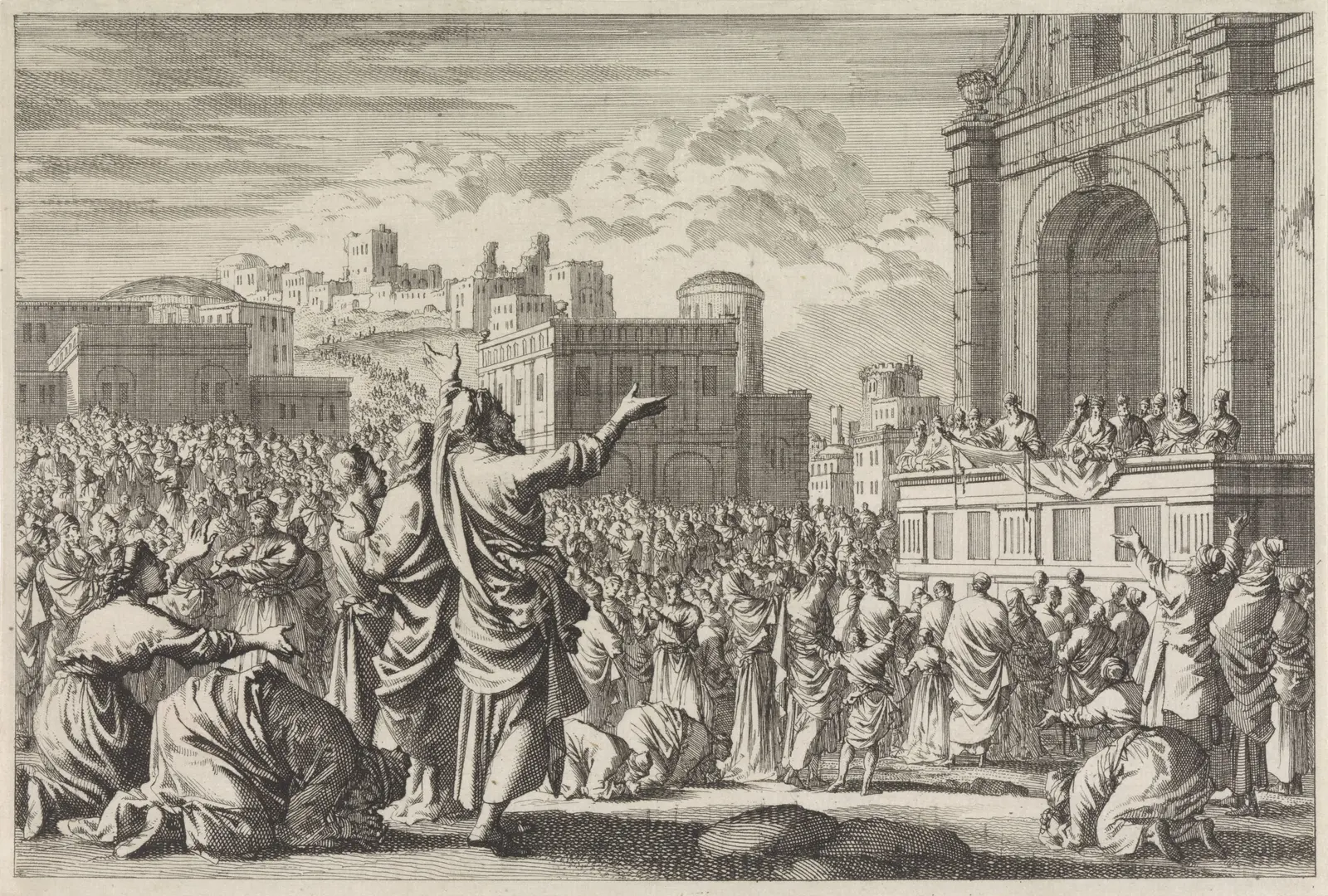
In a 1700 etching after Jan Luyken, Ezra stands high above the square near Jerusalem's Water Gate. The open book is small, almost lost among stone buildings and hundreds of bodies, yet every movement turns toward it. As some people kneel and others lift their hands, a gathered people receives words that none of them invented.
The image catches the first truth about Scripture in Nehemiah 8. The law is not discovered by a solitary reader seeking private illumination. The people ask for the book, Ezra reads it aloud, and the Levites help them understand. When the listeners weep, they hear that the day is holy and are sent to feast and share food with those who have nothing prepared.
Hearing becomes interpretation, repentance, worship, and material care. Scripture addresses Israel as a people and begins to reorder its common life.
Christians often divide over who is entitled to hold the Bible. Some fear that an authoritative church will imprison the text inside its own decisions, while others fear that private interpretation will make every reader a church of one. History gives grounds for both fears because institutions have silenced Scripture and isolated readers have made it say whatever their age already wanted to hear.
A more faithful answer begins with a paradox. Scripture belongs to the church, and for that reason it can never become the church's possession. The community receives a Word it did not author and cannot control. The Bible rests in the church's hands as gift, vocation, and judgment.
The Book Before the Reader
The church does not meet Scripture as a religious consumer meets a newly published book. Before any Christian opens a personal Bible, the words have already traveled through a people. Israel prayed the psalms, told the exodus, argued with its prophets, and guarded the law. The church received these Scriptures from Israel and therefore owes attention to the Jewish people whose witness it can neither replace nor treat as a discarded preface.
The writings of the New Testament also arrived within common life. Paul wrote to congregations and expected his letters to be read aloud. The Gospels gathered apostolic testimony for communities learning to confess, worship, suffer, and hope. Churches exchanged writings, tested them against the apostolic faith, and slowly recognized a canon across distance and disagreement.
This history does not grant later institutions ownership of the Word, but it does tell us what kind of book the Bible is. Scripture is addressed to a people and learned through practices of hearing, teaching, prayer, sacrament, moral discernment, and mission. Even a text read alone therefore carries the voices of translators, teachers, communities, and generations of interpretation.
The early church sometimes called its shared confession the rule of faith or rule of truth. Irenaeus compared a distorted reading to someone dismantling a mosaic of a king and rearranging the same stones into a poor image of a fox. Every piece might be genuine while the resulting picture was false. The rule identified the scriptural story of the one Creator, the saving work of Jesus Christ, and the life-giving Spirit so that individual passages could be recognized within the whole.1
Such a rule is not a secret key held by experts. It is the baptismal grammar by which Christians learn the identity of the God they address. It keeps a striking verse from becoming detached from creation, covenant, incarnation, cross, resurrection, and the promised renewal of all things. It also remains accountable to the Scriptures whose pattern it claims to name.
The Church Under the Word
The Reformation sharpened the danger of a church treating its interpretation as immune from correction. The Church of England's Article XX acknowledges real ecclesial authority in rites and controversies of faith, then places that authority under Scripture. The church may not decree what contradicts the written Word or interpret one passage against another because, as Article XIX states with unsettling candor, historic churches can err even in matters of faith.2
This did not make the reformers champions of interpretation without a church. They translated Scripture for public worship, preached it, wrote catechisms and confessions, founded schools, and ordered lectionaries. Their protest concerned the church under the Word, not a reader without neighbors.
Four centuries later, the Second Vatican Council gave Roman Catholic teaching a strikingly similar posture. Dei Verbum describes Scripture, tradition, and the church's teaching office as joined in the one work of receiving revelation. It then says that the teaching office is not above the Word of God but serves it by listening, guarding, and explaining.3
Important disagreements remain about canon, tradition, teaching authority, and the final court of appeal, and they should not be hidden by an easy ecumenical harmony. Yet both witnesses establish a condition that every tradition needs: ecclesial authority is faithful only as a ministry of reception. The church can proclaim the Word with confidence because it stands beneath the same address it announces.
Scripture's freedom is therefore more demanding than the freedom of a document left without interpreters. A neglected book cannot judge anyone. The living question is whether a community will read closely enough, widely enough, and truthfully enough to hear what contests its interests.
When the Church Closes Its Hand
The church can hold Scripture so tightly that the gift becomes a weapon. This happens when a familiar interpretation acquires the force of revelation, a leader selects passages that secure obedience while avoiding texts that judge authority, or a congregation hears calls to forgiveness without the accompanying demands of truth, protection, and repair. The same closure occurs when a nation borrows biblical language to make its ambitions appear providential.
The history of American slavery offers a severe example. Slaveholding Christians quoted Scripture in defense of mastery and enforced religious instruction designed to make bondage appear divinely ordered. In the appendix to his 1845 Narrative, Frederick Douglass answered by distinguishing the Christianity of Christ from the slaveholding religion he had encountered. That distinction was itself an act of Christian reading. It exposed an interpretation by setting its social fruit beneath the gospel it claimed to teach.4
The lesson cannot be that the right moral reader simply escapes tradition. Defenders of slavery and their opponents both read within communities, inherited arguments, and material interests. The lesson is that interpretation must be open to witnesses whom established power has trained itself not to hear. Enslaved Christians, abolitionists, Black churches, and later historians did more than add experiences beside the text. Their testimony revealed what a dominant reading required others to suffer.
The same discipline matters wherever Scripture has been used to conceal abuse, sanctify racial hierarchy, silence women, despise disabled bodies, or turn political loyalty into a test of faith. Attention to the wounded does not replace exegesis. It gives exegesis morally relevant evidence about the world an interpretation creates.
Historical and linguistic scholarship also serves this work. Knowledge of genre, manuscript history, ancient cultures, and the original languages can interrupt confident mistakes. Scholars remain fallible, and technical expertise cannot produce obedience. Still, contempt for study often leaves a community ruled by interpretations it has never learned to recognize as interpretations.
Faithful reading requires more than sincerity. It needs patient argument, accountable teachers, the memory of the saints, Jewish attention to Israel's Scriptures, voices from the global church, and the testimony of people who bear the consequences of doctrine. No single group supplies an innocent viewpoint. Together they can make self-deception harder to preserve.
A Communion of Hearers
Acts 15 shows the church discerning Scripture in the middle of a conflict it cannot avoid. To decide whether gentile believers must be circumcised and keep the law of Moses, apostles and elders gather to hear Peter recount the gift of the Spirit, Paul and Barnabas describe signs among the nations, and James interpret the prophets. The assembly then sends a letter that binds theological judgment to practices capable of sustaining fellowship.
The council is neither a mechanical deduction from a verse nor an assertion that experience has replaced Scripture. God's action, Israel's writings, apostolic testimony, pastoral consequence, and the demands of communion are considered together. The decision remains open to testing because it is announced in public and entrusted to the churches.
This pattern suggests what an ecclesial reading culture might require now. Reading Scripture aloud in worship frees its address from dependence upon private motivation, while preaching across the breadth of the canon keeps the Bible from becoming a storehouse of illustrations. Study should make real questions possible, and teachers should show how judgments were reached and where faithful Christians disagree. Within such a culture, those with authority should be the first to submit their habits to the text.
Common prayer contributes another discipline. In the daily office, Christians hear passages they did not choose and place them beside psalms, canticles, confession, intercession, and praise. The lectionary is not infallible, and no schedule can remove the work of interpretation. It can nevertheless weaken the appetite for a Bible composed only of favorite verses.
Personal reading belongs inside this communion rather than beneath suspicion. A Bible opened at a kitchen table, hospital bed, prison desk, or quiet room may become the place where the church's failures are first perceived and God's promise is heard anew. Private attention serves the common good when the reader can bring discovery, protest, confusion, and hope back to a people willing to listen.
The test of such a community is not interpretive unanimity, since Christians will continue to disagree about difficult texts and about the authorities that govern their reading. The deeper test is whether disagreement occurs under a shared willingness to be corrected. A church that can never be wrong has ceased to hear, and a reader who can never be taught has done the same.
Open Hands
Hebrews calls the Word living and active because God does not leave readers untouched. In discerning the purposes of the heart, Scripture names sin and announces judgment while also giving the promise of mercy. Its goal is the repentance, reconciliation, and life of a failed church rather than its humiliation.
That is why Nehemiah's assembly moves from tears to a shared feast. The book uncovers a people in order to restore them to joy, so understanding becomes generosity and holiness becomes a meal sent beyond the circle of those already prepared.
The Bible belongs in the church's hands because God intends to form a people through it, yet those hands must remain open. They receive the witness of Israel and the apostles, pass the words from one generation to another, and lift the book in public. In every act of reception and transmission, they also accept the judgment of the Word they carry.
The church reads faithfully when Scripture is allowed to do more than confirm the church's identity. It must expose the church's evasions, enlarge its memory, comfort those it has forgotten, and return every tradition to Jesus Christ. Then the community can become what it first was at the Water Gate, a people gathered by words it did not invent and sent to share the life those words give.