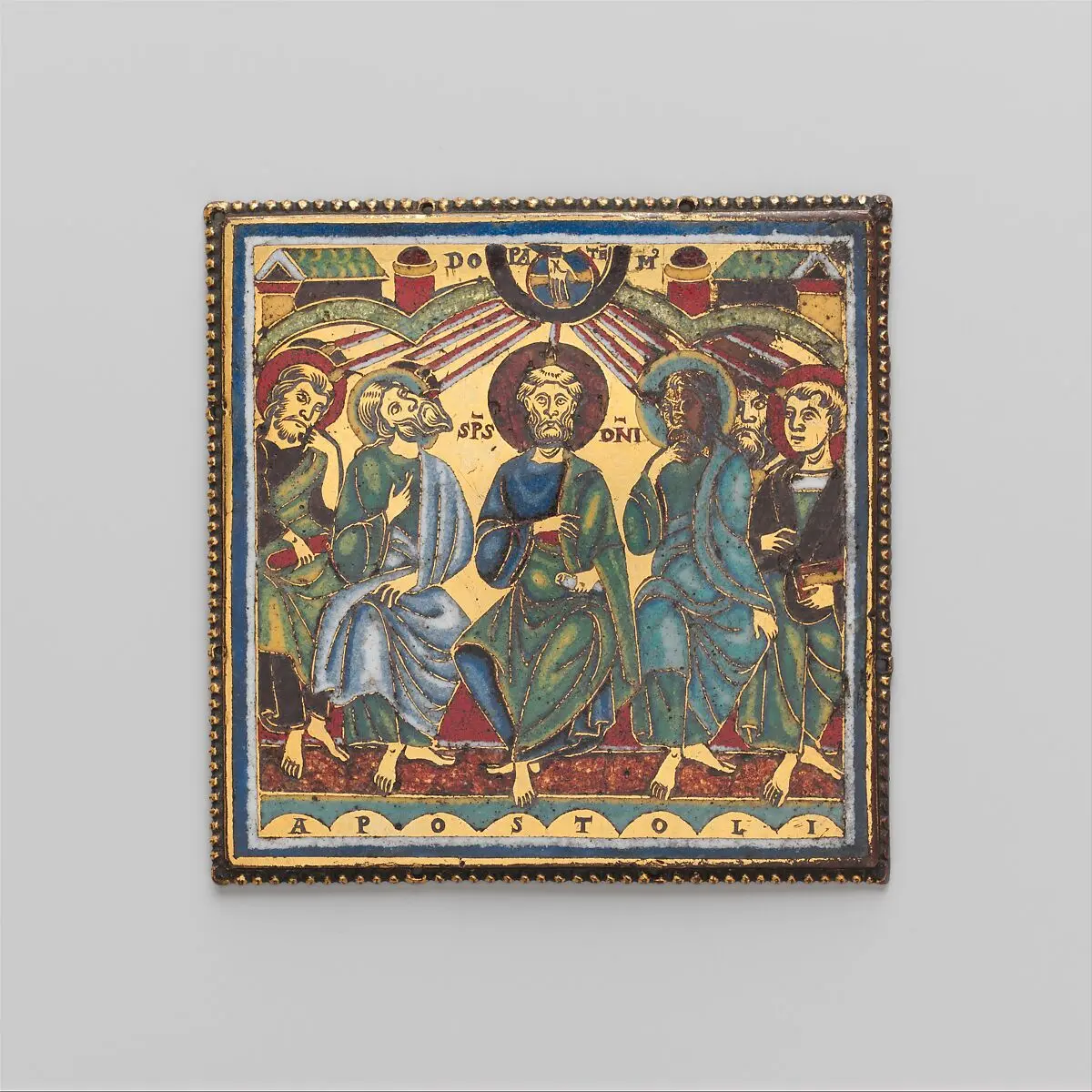
Six apostles sit shoulder to shoulder before Jerusalem. From the hand of God, six rays descend, one bending toward each disciple. Every person receives a distinct share in the gift, yet no one receives the Spirit alone.
The small enamel plaque compresses Pentecost into a theological grammar in which God gives himself to persons by gathering a people. The Spirit does not descend as private religious property, for he creates a body whose members receive one another along with the gift.
Modern Christians often imagine sanctification differently, picturing an individual who records victories over temptation as evidence of spiritual progress. Attention to personal faithfulness is necessary because no appeal to community can repent, forgive, or obey in my place.
The mistake begins when the personal becomes private. God consecrates a people in Christ, and the Spirit forms its members together through worship, truth, forgiveness, service, and shared suffering. Personal holiness takes shape through this participation in Christ within his body.
Sanctification is therefore neither an individual accomplishment nor an institutional possession. It is grace taking social form.
The Person and the People
Scripture begins the story of holiness with a people. God calls Abraham so that the families of the earth may be blessed. At Sinai, Israel becomes a priestly kingdom and holy nation. Worship, labor, justice, and care for the stranger belong to its common vocation.
Jesus continues this pattern by gathering twelve disciples as the sign of a renewed people. He calls persons by name and demands personal faith, yet he teaches them to pray as a plural and prepares a table at which belonging to him entails belonging with them.
The cross has the same corporate horizon. Christ gives himself to purify a people and make the church holy. First Peter moves from Christ bearing sins to the announcement of a chosen people and royal priesthood. The atonement creates a reconciled body whose life should correspond to the love by which it was redeemed.
Pentecost makes that body visible as the Spirit creates common speech across difference. The baptized devote themselves to apostolic teaching, fellowship, the breaking of bread, and prayer, with the result that possessions begin to serve need. Praise and material care become aspects of one life.
The Second Vatican Council restated this scriptural pattern when it taught that God does not sanctify disconnected individuals but gathers a people. The church is not a voluntary association assembled after salvation has happened elsewhere.1
Holiness Needs Neighbors
The fruits of the Spirit are personal qualities, but almost all of them require other people in order to exist. Patience is learned beside an inconvenient neighbor, kindness through seeking another person's good, and gentleness through the way power approaches vulnerability. Faithfulness endures within promises, while self-control protects a good larger than immediate appetite. Even joy and peace become Christian signs when they can be shared without denying another person's sorrow.
Paul's contrasting list of the works of the flesh is equally social. Enmity, strife, jealousy, rage, rivalries, dissensions, factions, and envy destroy communion. The flesh is not merely a collection of private appetites inside the body. It is a power that disorders relations. The Spirit's work must therefore become visible in reconciled forms of life.
One might reasonably ask why ordinary life in the world cannot cultivate these qualities. After all, every workplace, family, neighborhood, and friendship requires some measure of patience, generosity, fidelity, and restraint. People outside the church frequently display virtues that expose the failures of Christians.
Yet cultures cultivate the qualities required by the ends they desire. A commercial culture may teach patience when patience advances a career, self-control when it improves productivity, and generosity when generosity enhances reputation. A political culture may praise courage while directing it toward the defeat of an enemy. Even admirable qualities can be detached from worship, mercy, and communion. Culture cannot deliberately cultivate the godliness it does not desire because godliness is more than socially useful behavior. It is a life ordered toward God and conformed to the crucified Christ.
Christian holiness therefore needs a community that names communion with God as its shared end. Believers must live among others who are imperfectly seeking the holiness of God, learning together what truth, mercy, purity, justice, courage, and self-giving love look like beneath the lordship of Jesus. The church does not gather people who have already become holy. It gathers people whose competing desires are being reordered through Scripture, sacrament, prayer, correction, forgiveness, and service.
This deliberate community matters because no person can sustain an alternative form of life through private conviction alone. The surrounding culture continually teaches us what to admire, fear, purchase, excuse, and pursue, so Christian formation requires a people who rehearse another account of the good. Within that account, weakness does not erase dignity, possessions exist for service, enemies remain human, forgiveness requires truth, and power answers to the cross. Taken together, these convictions refuse to measure any life by usefulness alone.
The church will embody these convictions imperfectly. Its members bring the habits of the world into the sanctuary, and ecclesial cultures can cultivate vanity, domination, concealment, and exclusion as effectively as any other institution. Deliberate Christian community therefore requires repentance as one of its permanent practices. The church becomes a school of holiness only when it permits the gospel to judge the life it has actually created.
This exposes a weakness in popular accounts of sanctification. Christ's saving work is sometimes presented as though forgiveness delivers an independent quantity of moral power to the believer. Failure then seems to permit only two conclusions: either the person was never truly converted, or a victorious power was available and went unused. The first answer can become cruel, while the second can turn every repeated struggle into shame.
The gospel promises real transformation, but it does not describe autonomous moral energy. It announces union with Christ through the Spirit. Union with Christ entails incorporation into his body. A person fighting addiction may need prayer and self-command. That person may also need truthful friendship, removal from an exploitative environment, professional care, sacramental assurance, accountable limits, economic help, and a community that knows how to remain present after failure. Grace reaches persons through persons.
John Wesley's descriptions of the early Methodist societies show this conviction in practice.2 Members gathered in classes and bands, examined their conduct, confessed temptation, contributed to the poor, visited the sick and imprisoned, searched Scripture, fasted, prayed, and received Holy Communion. The General Rules joined doing no harm, doing good, and attending upon the ordinances of God.3 Holiness of heart and life required neighbors, practices, correction, and works of mercy.
Wesleyan social holiness includes public action, but its first claim is more basic. There can be no solitary holiness because love of God takes form in love of neighbor. Christian perfection is not private flawlessness. It is love filling the heart and ordering a life toward God and others. Holy dependence is healed into communion.4
The Practices That Make a Body
If sanctification is participation, the church's common practices are ordinary means through which the Spirit joins persons to Christ and teaches them to inhabit his life.
Baptism first places a named body within a prior communion. As water is received and rival lordships are renounced, the church accepts responsibility for a life it did not create. Baptismal identity is therefore personal without being self-authored.
Common prayer extends that baptismal belonging by giving the congregation words no individual owns. The Prayer Book teaches Christians to say we as they confess sins beyond private memory, ask for daily bread in a hungry world, and pray for the living and the dead. Borrowed words enlarge moral attention.
The Eucharist intensifies this formation. Bread and wine are received rather than achieved, and social distinctions are brought beneath one invitation. At Corinth, some ate abundantly while others went hungry. Paul judged this as an inability to discern the body. The table tells the truth about the church, then calls the church to become what it receives.
What the table displays must also become possible in the church's handling of sin. Confession makes sin speakable, absolution prevents truth from ending in despair, and the peace directs reconciliation toward another person. Discipline then names conduct that injures the body. Governed by the gospel and open to repentance, these practices become means of sanctification.
The church is both the medium and the object of sanctification. Grace reaches persons through an embodied communion, while Christ intends to present that communion as holy. The Spirit is building a dwelling, not parallel spiritual lives.
When the Body Is Wounded
Corporate sanctification raises the standard of judgment. Racism, concealed abuse, economic indifference, partisan captivity, and exclusion are not distractions from an otherwise successful ministry. They are wounds in the body and contradictions of the holiness it confesses.
An idealized doctrine can float so far above actual congregations that their conduct no longer matters. Leaders defend the institution while making truth difficult to speak. Unity becomes a demand placed on the wounded rather than a gift pursued through judgment and repair.
Paul allows no such separation because if one member suffers, all suffer. Safeguarding, accountable authority, and material repair are therefore ways of discerning the body. A church that conceals harm to preserve its reputation has denied the witness it seeks to protect.
Corporate holiness cannot dissolve personal responsibility. A congregation cannot confess unless persons tell the truth, share unless persons release what they control, or reconcile unless persons endure the cost of repair. The personal and corporate make one another morally concrete.
Nor should churches imagine a moral league table. Non-Christians display courage, fidelity, generosity, and sacrificial love, while Christians remain capable of grave evil. The more exacting question is whether Christ is creating among Christians a life that cannot be explained by self-interest, fear, or shared resentment alone.
Social credibility can be tested through concrete questions. Can vulnerable people tell the truth without retaliation, and are leaders accountable to those they serve? Does money move toward need, and do confession and forgiveness lead to repair? Are children, single people, disabled people, and those without status received as full members? Can political opponents remain at one table without pretending their disagreements are trivial? Above all, does worship make the congregation more available to its neighbors?
These questions do not measure the whole mystery of sanctification. They do ask whether grace is becoming socially credible.
A People for the Life of the World
The Pentecost plaque does not portray identical apostles. Each receives a ray and will follow a different path because the Spirit differentiates gifts even as he directs them toward the building up of the body.
Christian communion should make persons more particular, not less. The eye remains an eye and the hand a hand. Holiness does not absorb conscience into the group or require obedience to leaders claiming to speak for the whole. The Spirit creates mutual dependence under Christ.
This body exists for more than its own coherence because the Spirit equips the church for witness. Sanctification turns outward through hospitality, justice, mercy, evangelism, peacemaking, beauty, and patient presence. A church absorbed in proving its holiness has forgotten why holiness was given.
The aim is not a flawless institution. Churches remain wounded communities requiring judgment beneath the cross. Their holiness begins in Christ's gift, takes form through the Spirit, and reaches fulfillment in the new creation.
That promise frees the church from performance without releasing it from obedience. We can name failure because the church's identity rests in grace, then pursue repair because grace intends an actual people rather than an invisible ideal.
Sanctification is not a private achievement because holiness is the life of Christ shared through the Spirit rather than a private possession. That life comes to us through water, Scripture, bread, prayer, correction, friendship, suffering, forgiveness, and service. Each person becomes responsible within these relations, and no one is left alone.
God is not merely improving religious individuals. God is gathering a people in whom the life of Jesus can be received, practiced, tested, repaired, and offered for the life of the world.