Every age teaches the church what to mistake for faithfulness. Ours teaches us to mistake visibility for reality. An act becomes legible when it can be photographed, counted, circulated, and attached to a recognizable identity. The work of prayer, mercy, study, leadership, and repentance enters the same economy. We learn to ask how spiritual life appears before asking what it is becoming.
This temptation did not begin with social media. John Cassian described vainglory in the fifth century as a vice capable of changing its clothing. It could seize a monk through elegant dress or shabby dress, eloquent speech or chosen silence, public fasting or carefully concealed fasting. Pride could even make humility into evidence of distinction. Digital platforms did not invent this desire, though they have given it numbers, archives, and an audience that never fully leaves the room.1
Public witness still belongs to Christian life. The church proclaims the gospel, feeds people, names injustice, teaches the faith, and invites neighbors into a visible communion. Jesus tells his disciples that a lamp belongs on a stand. Visibility can make neglected suffering harder to ignore and public accountability harder to evade. The danger begins when attention becomes a sacrament of legitimacy, as though the visible response certifies the presence of grace.
Churches also need honest measures. Attendance, giving, participation, and patterns of decline can reveal whether a community is reaching its neighbors or avoiding difficult realities. Refusing every measure may protect negligence behind spiritual language. The figures remain instruments of pastoral attention rather than verdicts on divine action. A crowded church can cultivate spectators, while a struggling parish can become absorbed in its own survival. Numerical growth and numerical decline both require interpretation beneath the gospel. Neither can tell us by itself whether people are learning truth, mercy, courage, repentance, and love.
Because neither publicity nor numbers can render a final judgment, the Christian tradition offers a stranger account of reality. Much of what God does remains concealed within forms the world has little reason to admire: the kingdom appears as seed, yeast, a child, a meal, and a crucified man. The life of the baptized is hidden with Christ in God, under the gaze of the Father who sees in secret. These claims do more than commend modesty. They describe where and how Christians expect God to be known.
The God Known Under Contrary Signs
Scripture does not present divine hiddenness as simple absence. God hides by drawing near in ways that unsettle our habits of recognition. Elijah stands at Horeb while wind tears at the mountain, the earth shakes, and fire passes before him. God is not located in the sequence of overwhelming forces. Elijah finally covers his face before the thin silence that follows. The episode does not turn quiet into a technique for controlling God. The God who had spoken from Sinai in thunder now refuses the prophet’s expected theater of power.
The pattern reaches its center in Jesus Christ. God enters history without the forms by which human beings usually identify importance. Jesus spends most of his earthly life in the obscurity of Nazareth. His ministry gathers crowds, yet he repeatedly withdraws, resists demands for signs, and refuses the political shape others would give his vocation. The glory of God becomes most difficult to recognize precisely where the Gospel identifies it most decisively.
Paul calls the crucified Christ the power and wisdom of God. Crucifixion displayed Roman power by making the condemned body visible as an object of defeat. Christian proclamation makes that same body the disclosure of divine self-giving. God is known under a sign that appears to contradict divinity. Glory is hidden in humiliation, victory in surrender, and life in death.
Martin Luther gave this pattern enduring language in the 1518 Heidelberg Disputation. The theologian of glory looks through impressive works toward a God imagined in the image of power. The theologian of the cross receives the knowledge of God where God has chosen to be manifest, in suffering and the cross. Such theology calls a thing what it is. It does not rename evil as good simply because religious language has been placed around it.2
That final distinction matters because the cross does not make suffering inherently holy. Failure, humiliation, illness, abuse, and obscurity carry no automatic evidence of divine favor. God’s revelation in the crucified Christ instead judges the powers that inflict suffering and accompanies those they wound. Divine hiddenness names God’s freedom to be present beneath the world’s measures of success without ever granting the church permission to romanticize pain.
Hiddenness also preserves the difference between God and every image of God we can manage. Christian theology has long spoken of divine mystery because the Creator exceeds creaturely comprehension. The Incarnation gives that mystery a human face without making God available for possession. Jesus can be heard, touched, rejected, and followed, yet his identity is received through faith. At the cross, revelation and mystery intensify together. God has truly given himself, and what God gives overturns the very expectations by which religious people thought divinity could be recognized.
The One Who Sees in Secret
This freedom from the world’s measures becomes a question of desire in the Sermon on the Mount. Almsgiving, prayer, and fasting were substantial practices of Jewish devotion, and Jesus assumes that his disciples will continue them. His concern is the audience before whom they are performed and the reward toward which desire has been trained.
The person who gives in order to be noticed receives notice, just as the person who prays in order to appear prayerful receives a reputation for prayer. These rewards are real and often pleasant, yet they remain complete within the small economy that produced them. The act has been turned outward until the neighbor’s gaze becomes its destination.
Jesus redirects the disciple toward the Father who sees in secret, making the hidden room more than a private location. There the self can no longer depend upon an audience to confirm that prayer occurred. Words may feel thin, attention may wander, and no image can prove sincerity. The worshiper is left with God, need, and a promise that the unseen encounter is not empty.
Common prayer serves this hidden life in an unexpected way. Although a congregation is visible, its deepest action cannot be reduced to display because the church gathers to receive words and gifts it did not invent. A person can enter the liturgy without producing intensity, originality, or an account of spiritual progress. Through psalms prayed, sins confessed, peace exchanged, and bread received, a life is created that will remain largely unavailable to measurement.
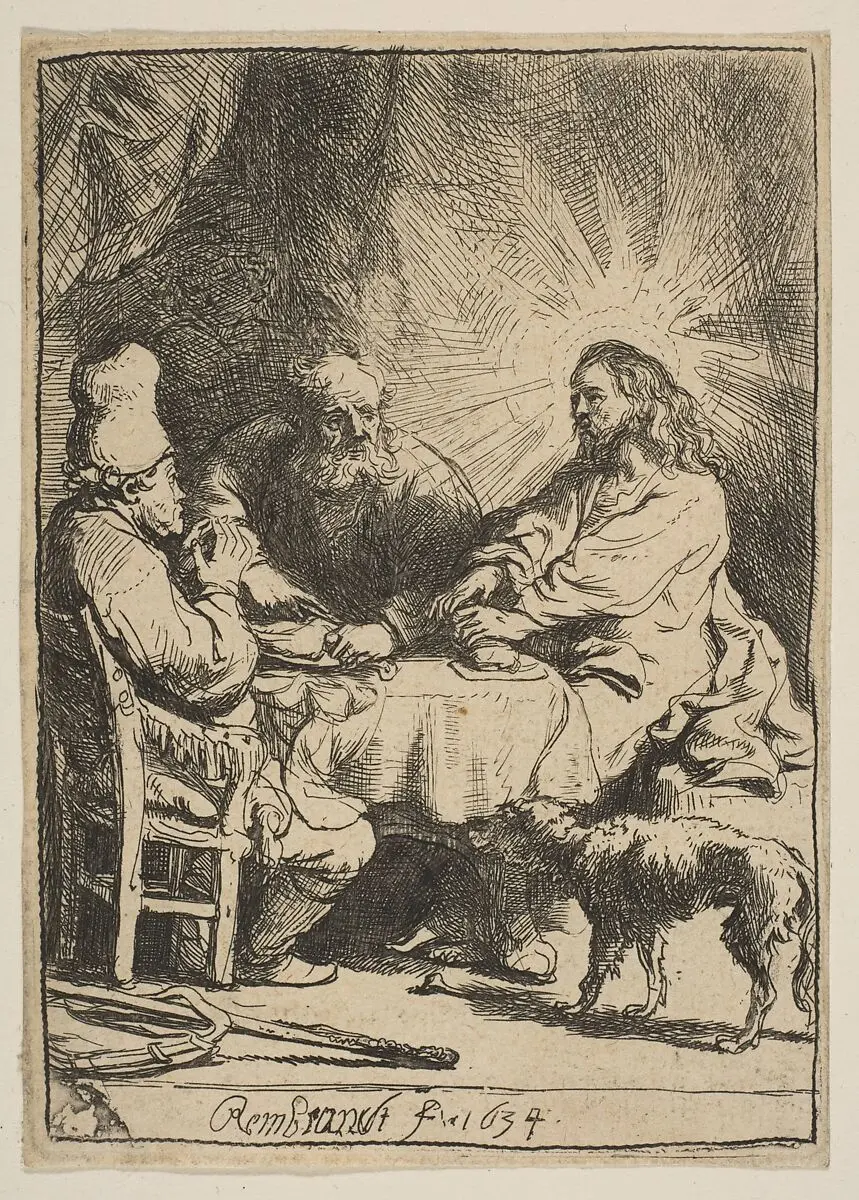
Rembrandt’s Christ at Emmaus places this mystery around an ordinary table. Luke tells us that the disciples had walked with the risen Jesus while their recognition was withheld. They heard Scripture from the mouth of a stranger. Only in the blessing and breaking of bread were their eyes opened. Rembrandt gives the viewer the radiance that the travelers perceive at last, yet he surrounds it with a cramped room, worn furniture, a simple meal, and a dog beneath the table. Resurrection arrives within the texture of common life.
Emmaus gives divine hiddenness a sacramental grammar in which Christ is present before he is recognized and recognition comes as gift rather than achievement. Once the disciples see him, he vanishes from their sight and sends them back to the gathered church. Faith therefore does not secure the visible Jesus as a permanent possession. It learns to receive his presence through Scripture, broken bread, hospitality, and testimony.
The sacramental life therefore resists the demand for spiritual proof. Water still looks like water, and bread remains available to the senses as bread. The church trusts Christ’s promise without requiring a corresponding intensity of feeling from every communicant, so those who approach in joy kneel beside others who arrive distracted, numb, doubtful, or exhausted. The gift rests in God’s faithfulness and is received within a body whose life exceeds the experience of any member. This protects the weary from having to manufacture an encounter worthy of display.
Hiddenness Without Evasion
The freedom promised by hiddenness can be counterfeited by secrecy. Institutions conceal misconduct and call secrecy prudence, leaders avoid evaluation by treating questions as attacks on spiritual authority, and communities ask wounded people to suffer quietly so the public appearance of unity can be preserved. In those settings, hiddenness protects power rather than freeing faith from performance.
The God hidden under the cross opposes such concealment by bringing wounds into truthful speech. Christian confession accepts exposure, and justice gives that repentance a public form through records, witnesses, safeguards, and repair. The private room of prayer cannot become a locked chamber in which another person’s harm is made invisible.
Visibility also matters for those whose labor has long been ignored. Caregivers, cleaners, junior workers, children, people with disabilities, and members of marginalized communities are often told that unseen service is spiritually beautiful while others receive authority and recognition. The gospel honors hidden faithfulness while calling the church to see the people it has trained itself to overlook. The Father’s secret knowledge should sharpen human attention to the neighbor.
Christian hiddenness therefore requires discernment between what love withholds from applause and what fear or power withholds from truth. The cross distinguishes them by revealing a God who relinquishes status for the life of others and exposing systems that preserve status by sacrificing others. Hidden faithfulness gives itself away, while corrupt secrecy makes someone else bear the cost.
The same discernment protects us from treating smallness as a virtue in itself. A small congregation may be faithful or cruel, a quiet ministry patient or inert, and a public success providential or vain. Neither numbers nor their absence can decide these questions. Fruit is recognized through truth, mercy, justice, communion, and fidelity to Jesus Christ.
Faithfulness Without Proof
The hiddenness of God becomes difficult when the hidden life feels less like freedom and more like abandonment. Prayer may continue without consolation, work may bear little visible fruit, and a congregation may decline despite patient care. In such seasons, a person can obey within an ordinary vocation while wondering whether anything is being formed, and the promise of the God who sees in secret can sound fragile.
Christian faith offers no formula for turning obscurity into future success. The seed may grow without our understanding, and some seeds appear to die. The cross keeps the church from promising that faithful effort will eventually become legible as influence. Resurrection is God’s vindication of the crucified Jesus, not a guarantee that every worthy project will flourish on our preferred timetable.
What hiddenness gives is a different location for the self, since our lives are hidden with Christ in God and receive their meaning within his life before it becomes visible in achievement, reputation, or emotional certainty. Baptism names a person through promise, the Eucharist feeds a communion whose final form has not appeared, and prayer returns the worshiper to the One from whom no act of love, no truthful lament, and no wound is concealed.
This new location changes public Christian life by loosening our need to make each word establish an identity or each act of service prove our goodness. Because failure does not erase the promise of baptism, we can admit it, and because visible fruit is never the whole work of God, we can celebrate it without depending upon it. Some acts of mercy can then be left without a record.
A church formed by divine hiddenness will still be visible. It will gather, preach, sing, protest, feed, baptize, bury, and bear witness. Its visibility will point beyond itself. Its members will know that the deepest realities they receive cannot be manufactured for an audience. Christ remains free to meet them as a stranger on the road, in the words of Scripture, at an ordinary table, and among the neighbors whose lives the world has learned not to see.
Spiritual performance asks to be assured that grace is present because someone is watching. The gospel announces a Father who already sees, a Son whose glory is disclosed under the cross, and a Spirit who gives life beyond our control. Faith can therefore become quiet enough to tell the truth and public enough to serve the neighbor. It can act without possessing proof of its importance.
Much of that life will remain hidden, yet none of it is lost to God.