The communicant comes to the altar rail with empty hands. A week of distraction may have thinned prayer. Grief may have made every word difficult. The church asks for no report on the weather of the soul. Bread is placed into the hand with an older and steadier word: “The Body of our Lord Jesus Christ, which was given for thee, preserve thy body and soul unto everlasting life.”9
Everything in that sentence turns toward the giver, for Christ is the subject whose body was given and whose life preserves. The communicant receives before offering any evidence of spiritual success. Feeling may follow, and often does, though the promise rests elsewhere.
An Anglican account of the sacraments begins here, within the action of common prayer. Theology rises from words spoken over water, bread, and wine, from bodies gathered around one font and one table, and from the scriptural story those rites rehearse. The church discovers what a sacrament means by receiving it in faith and learning to live from the gift.
Disenchantment is sometimes described as the disappearance of wonder from the modern world. Yet wonder remains plentiful. People still seek transcendence in art, nature, politics, romance, technology, and the self. The deeper loss is a habit of seeing matter as mute and religion as an inward meaning laid over an otherwise closed world.
The sacraments answer that loss without manufacturing an atmosphere of mystery. They announce that creation has already been addressed by God. The Word through whom all things were made has taken flesh, and he continues to meet embodied people through the creaturely signs he gives to his church.
A World Addressed by God
Scripture holds God and the material world together without confusion. Creation comes from the speech of God and is called good. Israel learns divine faithfulness through land and harvest, oil and blood, washing and shared meals. The prophets condemn worship that has become false, while continuing to call Israel into truthful, embodied praise.
In Jesus Christ, the Creator takes flesh from creation. The Word who becomes flesh touches the sick, eats with sinners, washes feet, blesses bread, shares a cup, and bears the wounds of crucifixion into his risen life. Matter remains creaturely even as it is drawn within redemption. In the incarnate Son, created life becomes the place where God's mercy is heard, touched, and received.
Baptism and Eucharist belong to this history. At the font, ordinary water is joined to Christ's command and the triune name. At the table, bread and wine are taken into thanksgiving, blessed, broken, poured, and given. The natural life of these things remains as water runs through the fingers and bread nourishes a mortal body. Their sacramental use comes from Christ, who takes what he has made and appoints it to bear his promise.
Luther makes this plain in the Large Catechism. Apart from God's word, baptismal water is the same water used for cooking. Joined to Christ's command, it becomes a gift on which faith may depend.2 Calvin likewise calls a sacrament an outward sign through which God confirms his promise and strengthens weak faith. The Spirit gives the sign its fruit, freeing the element from every fantasy of a sacred force held within it.3 The Reformers' disagreements with Rome were substantial, though neither man imagined Christianity as an escape from creaturely life.
Other Christian voices widen the vision. The Second Vatican Council speaks of sacraments that impart grace while nourishing faith, worship, and charity.4 The Catholic catechism distinguishes Christ's action in the sacrament from the fruitfulness of its reception in a particular person.7 Alexander Schmemann describes created life as gift, thanksgiving, and communion restored in Christ.5 These witnesses preserve real differences over sacramental presence while sharing a vision of grace addressed to embodied life.
Anglican prayer contributes a characteristic reticence to this conversation. At the moment of communion, explanation yields to administration. The liturgy names the gift, places it into the communicant's hands, and teaches the heart to feed on Christ by faith with thanksgiving. The doctrine is carried by an action spacious enough for reverence and precise enough for trust.
The Promise Given for Thee
The old words “given for thee” bring a vast claim to the scale of one receiving body. They release the communicant from a search for sufficient sincerity and direct faith toward Jesus Christ, crucified and risen, whose gift precedes our response.
This is the mercy of sacramental assurance. Whether a frightened parent carries a child to the font, a doubting Christian approaches the table, or a dying person receives communion when speech and concentration have nearly gone, the church bears the same witness. Christ is faithful, and weak faith is given somewhere beyond itself to rest.
Faith matters as the open hand of trust. It neither supplies the sacrament's power nor renders the person passive, for the gift itself draws forth thanksgiving, repentance, obedience, and love. Grace begins the movement to which the Christian life answers.
Where magic seeks leverage over holy power, sacrament teaches reception. The priest ministers the gift under Christ's authority because the rite belongs to Christ before it belongs to any parish, party, or personality. Liturgical exactness serves this humility when it keeps the church attentive to what it has received. It becomes a distortion when performance is used to hide pride or secure control.
Sacramental confidence also requires humility toward Christians who understand Christ's commands differently. The Salvation Army speaks of incorporation into Christ by the Spirit and a life of discipleship and service while declining to make a particular outward rite necessary to grace.6 Its witness reminds sacramental churches that they possess no monopoly on embodied faith. An Anglican may still receive Baptism and Eucharist as gifts appointed by Christ, while entrusting the reach of divine mercy to God.
One Bread, One Body
The words “for thee” are both personal and common. The altar rail gathers strangers into one posture of need. Each receives the same bread from the same table. The sacrament gives Christ to the communicant and gives the communicants to one another as members of his body.
Paul's rebuke in First Corinthians 11 belongs at the heart of eucharistic faith. In Corinth, some feast while others go hungry. The apostle names their division as a contradiction within the sacramental assembly. To receive the body of Christ while humiliating his members is to eat and drink judgment.
An early description of Sunday worship makes the same joining visible. Justin Martyr writes of an assembly where offerings are gathered for widows, orphans, the sick, prisoners, strangers, and others in need.8 The Eucharist reveals the shape generosity must take, even as human sin resists its schooling. Those who have received life as gift learn to make room at the table and beyond it.
Sacramental assurance comforts the weak and places power under judgment. The holiness of the altar intensifies a minister's responsibility toward a wounded person and releases that person from any demand to return to an unsafe congregation. A church that speaks of one body must provide trustworthy ways to hear a complaint beyond the control of the person accused. It must also learn how actual bodies come to the font and table, including bodies marked by disability, illness, trauma, or age.
The same attention extends outward. Water at the font has passed through rain, river, pipe, and human labor. Bread and wine arrive through soil, weather, cultivation, transport, and hands often unseen by the congregation. Thanksgiving makes these dependencies audible. A church washed and fed by gift should become attentive to thirst, hunger, exhausted labor, and every neighbor pushed from the common table.
The Broken Chalice
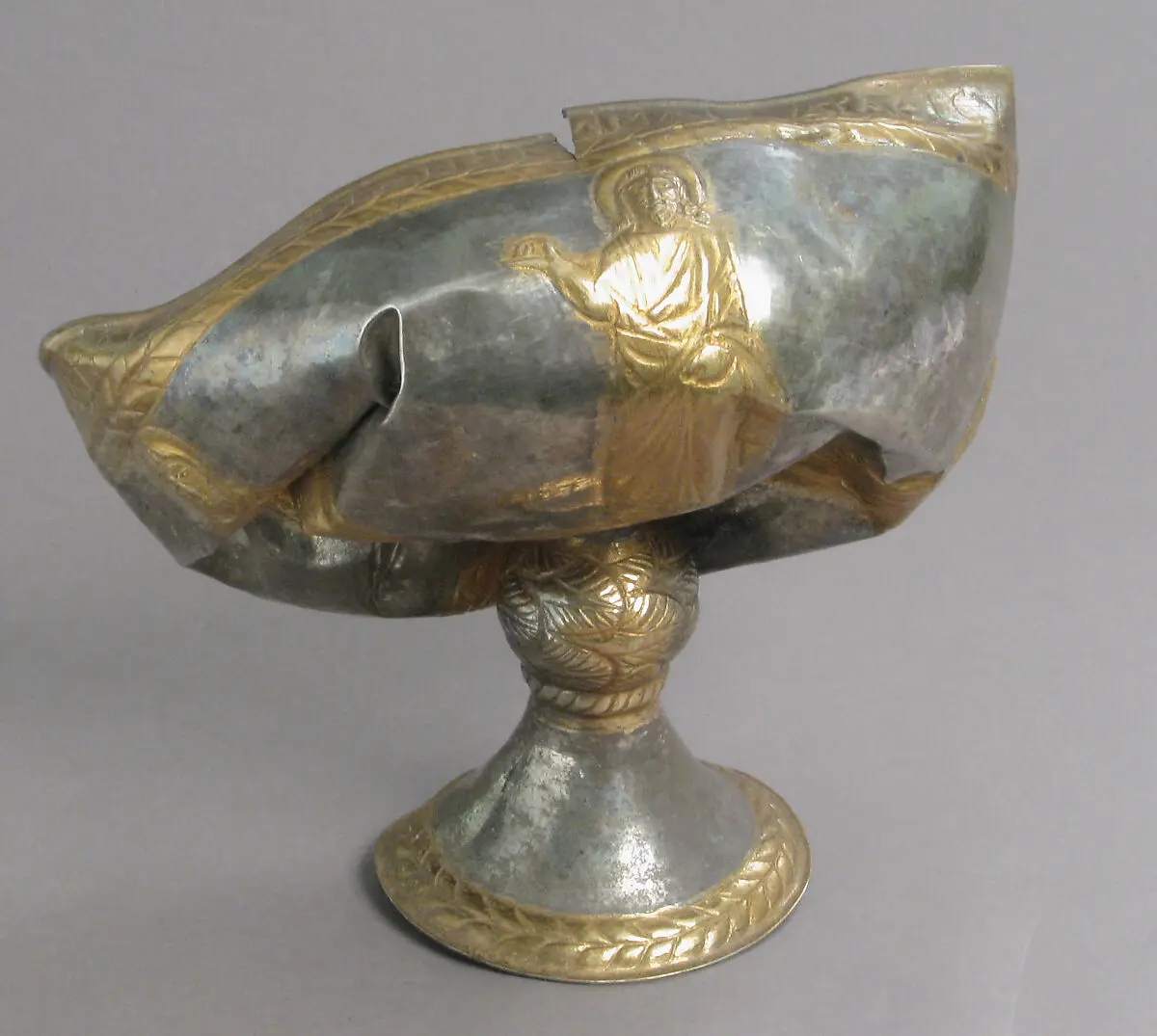
The chalice pictured above was made in Byzantine Syria sometime between 500 and 650. The Metropolitan Museum of Art identifies it with the Attarouthi Treasure, a group of liturgical objects probably buried during military upheaval.1 Its silver catches the light across a bowl torn open.
The broken rim refuses nostalgia. No surviving vessel can prove that an earlier church was purer, more reverent, or more fully alive to God. The chalice has passed through violence and burial into a museum case. The people who once drank from it have returned to dust. Its beauty comes to us bearing history's wound.
The damaged chalice gives an honest frame for sacramental hope because the church receives Christ within a vulnerable creation. Its water can be spilled, its bread grows stale, and its wine is poured out. The same mortality reaches its buildings, its ministers, and its people.
The Prayer Book knows this mortal register. It carries the church from birth to burial, through sickness, marriage, repentance, thanksgiving, and death. At the table it joins heavenly promise to food that disappears in the eating. The fragile sign is suited to creatures whose life depends upon continual receiving.
The chalice therefore bears no secret power of its own. It bears witness to hands that once lifted it in thanksgiving and to a promise entrusted to perishable things. Its wound keeps sacramental faith close to the cross, where divine glory is disclosed in a body given and broken for the life of the world.
Until He Comes
Baptism joins a mortal life to Christ's death and resurrection. Eucharist proclaims his death until he comes. The sacraments place the present within a future beyond the church's making, a future in which creation is reconciled and the dead are raised.
This future arrives as promise rather than sensation. The communicant may come away consoled, awakened, or full of joy. The communicant may also feel very little. Christian hope lets grief remain grief while asking whether Christ can be trusted when the heart has no brightness of its own.
At the rail, the church answers by giving what it has received. Bread touches the hand, wine reaches the lips, and a word of promise is spoken aloud while other Christians kneel nearby, equally needy and equally summoned into love. The ordinary world has become a place of divine address.
The communicant rises still carrying grief. Nothing requires that grief to be renamed as consolation. Yet something has been given: the church beside us, the gifts of creation, and the faithfulness of Christ spoken into mortal flesh. We return to ordinary life with no private radiance to display. We go as people washed, fed, and sent, trusting that the world is held by the Word through whom it was made and that even these fragile bodies will be gathered into his joy.