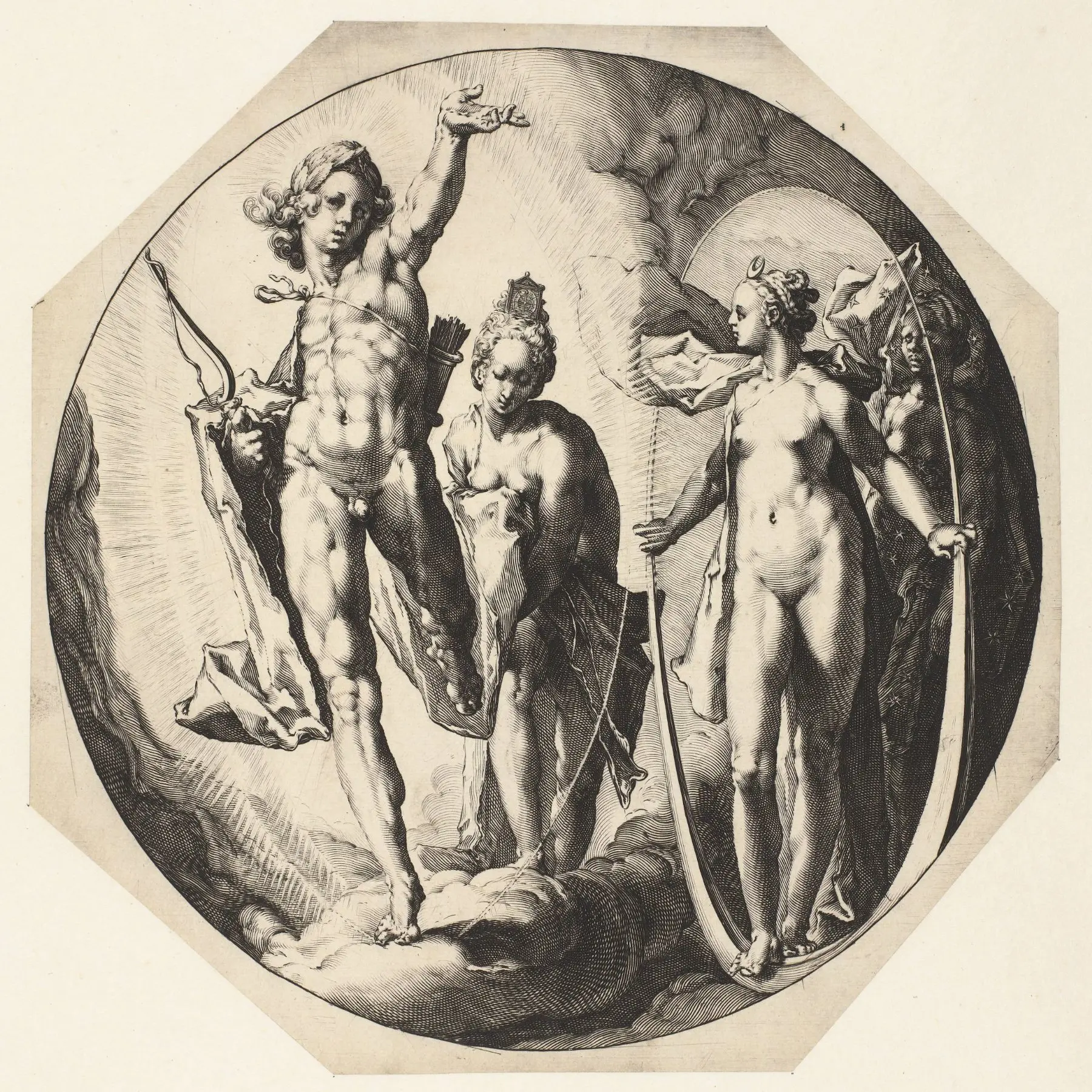
In 1589 Jan Harmensz. Muller engraved the fourth day of creation after a design by Hendrick Goltzius. The Rijksmuseum identifies Apollo as the sun, Diana as the moon, Time with a clock on her head holding Apollo's mantle, and a Black woman in a starry cloak personifying the stars. Biblical creation appears through the visual language of classical divinity.7
The image does not offer a tidy distinction between revelation and natural religion. It shows how human beings receive the world through inherited languages. The regular return of day and night is observed before it is explained. Its order can become a sign of providence, a field of scientific inquiry, a calendar for worship, or a story about rival gods. The same heavens can summon praise and invite idolatry.
Here natural religion means the religious interpretations and practices people develop in response to the world they encounter. It is broader than natural theology, which reasons about God from created realities. Neither is identical with bodily dependence itself. A person can recognize that dependence while declining any religious account of its meaning.
The Body Learns Before It Argues
The experience to be interpreted begins beneath formal proof in a body that wakes, hungers, grows tired, and depends upon water. Calling that dependence creatureliness is already a theological reading, while confessing its giver as the God revealed in Christ makes a further claim. Keeping those steps distinct lets Christians receive scientific knowledge without pretending it has already made their confession.
The National Institute of General Medical Sciences describes circadian rhythms as daily changes in bodily processes influenced especially by light and darkness, alongside other environmental cues. Its account explains how fruit-fly research on clock proteins and molecular feedback contributed to the work honored by the 2017 Nobel Prize.1 This is an account of biological timing, not a study of prayer or religious experience.
These findings do not prove God. A molecular feedback loop is not a concealed theological argument. It is evidence that embodied life is temporal, responsive, and fitted to conditions it does not create. Night shift workers, parents of infants, travelers, and people with sleep disorders know that this fitting can be disrupted. Creation is ordered, but our participation in its order is vulnerable and unequal.
The church's daily prayer receives this bodily truth without pretending to discover it first. Morning and evening prayer answer light and darkness with praise, confession, Scripture, and intercession, making hours that human creatures already inhabit into occasions of address. Prayer neither creates the dawn nor makes it ours. It receives dawn from the Creator and directs gratitude beyond the created light.
A Witness Given in Creation
Scripture speaks more generously about created testimony than some Christian defenses of revelation allow. Psalm 19 says that the heavens declare the glory of God without speech. Paul tells the people of Lystra that God has not left himself without witness, giving rain, fruitful seasons, food, and gladness. In Athens he can quote pagan poets because even an altar to an unknown god records a searching that the gospel may address.
Christians must distinguish knowledge through creation from the grace that enables a saving response. Thomas Aquinas argues that reason can move from effects toward knowledge that God exists, while also holding that revelation is necessary for saving truths beyond reason's discovery.23 The Westminster Confession similarly affirms creation's testimony while denying that it supplies the knowledge necessary for salvation.8 Dei Verbum makes the same distinction between natural knowledge of God and faith enabled by grace.6
John Wesley's account of prevenient grace concerns God's action before a person's conscious response. He explicitly treats what is often called natural conscience as already dependent upon grace.4 This is not another theory of reasoning from nature. The distinction prevents the essay from treating every encounter outside Christian confession as merely an unaided human achievement, or conversion as the successful completion of an argument.
Justin Martyr's Second Apology accounts for truth in Greek philosophy through partial participation in the Word, whose fullness he identifies with Christ.5 A neighbor may hear this as annexation, as though Christians honor another person's wisdom only by relabeling it. That objection cannot be settled by explaining that the Christian intention is generous. The neighbor may understand the account accurately and still reject it.
Christians can confess the Word's presence without demanding agreement as the price of listening. A neighbor may correct the church's description of a tradition, its account of a history, or a practice that excludes people. Such correction requires an answer on its own evidence. It need not become an occasion for the church to claim that the speaker was really making a Christian point.
The World Does Not Interpret Itself
Created order is real, but its meaning is contested. A biological regularity does not, by itself, confer authority or determine a person's worth. If an account of nature makes existing hierarchies appear inevitable, its movement from observation to moral command needs to be argued, not assumed.
Nature alone cannot decide which reading is faithful. It contains mutuality and predation, abundance and famine, birth and death. Human reason encounters this world through desire, history, social location, and institutions that reward some interpretations over others. A theology that moves too quickly from observable pattern to divine command can make existing power appear eternal.
The problem is especially clear when statistical regularity becomes moral norm. Most bodies may follow one pattern without making every variation a defect in human worth. A circadian rhythm may describe how organisms ordinarily coordinate with light and darkness, but it does not pronounce judgment on the nurse working overnight, the person living with chronic insomnia, or the blind person whose relation to light differs. Description becomes oppression when the majority's pattern is made a measure of belonging.
Romans 1 holds together revelation and distortion. God's power is perceived in the things that have been made, yet human beings exchange divine glory for images of creatures. The problem therefore lies less in creation's silence than in our capacity to turn witness into possession and gift into a mirror of our own rule.
The theological danger is making nature, culture, nation, or human capacity an authority independent of God's self-revelation. This essay therefore proposes a test for its own reasoning. Where an appeal to providence merely sanctifies an inherited social order, Christians should ask which evidence could challenge the claim and whose voice has been excluded from judging it.
Yet the protest should not make creation foreign to revelation. The God who speaks in Christ is the Creator, and the Word who became flesh is the one through whom all things came to be. Christian revelation does not introduce a rival deity who rescues souls from an unrelated material world. It names the Creator's purpose and exposes how that purpose has been obscured.
Fullness Has the Shape of Christ
The Second Vatican Council's Dei Verbum calls Christ both mediator and fullness of revelation, a fullness that is personal and historical. God is made known through the Son's words and deeds, his death and resurrection, and the sending of the Spirit. Revelation therefore gives more than information unavailable to unaided reason, for God gives himself and draws creatures into communion.6
That difference matters. A person may reason toward a first cause, discern moral obligation, or sense dependence upon a source beyond the self. None of these achievements is identical with being addressed by the God of Abraham, Isaac, and Jacob, forgiven by Christ, and incorporated by the Spirit into a reconciled people. Christian faith concerns the identity and action of God, not only the highest conclusions available to religious thought.
Because revelation is communion, it also changes the knower. The gospel announces mercy to sinners and creates witnesses, an encounter that natural wisdom cannot manufacture and ecclesial recognition cannot control. Acts 10 portrays Peter learning from the Spirit's action among people he had not yet received. The decisive distinction is therefore not between outsiders who merely reason and insiders whom God addresses. God's initiative can expose the limits of the church's expectations.
Colossians places this disclosure within a cosmic horizon by identifying Christ as the one through whom and for whom all things are created. In him all things hold together, and through the blood of his cross God reconciles all things. Creation's coherence is thus known in the crucified reconciler, whose identity becomes the Christian measure of religious knowledge.
The cross judges readings of nature that glorify strength, purity, success, or survival. The resurrection judges the conclusion that decay and death speak creation's final word. Christ does not erase the wisdom learned through bodily dependence. He reveals its deepest end as communion with God and neighbor, a communion given by grace rather than achieved through mastery.
Fulfillment must therefore be spoken without a claim to own the neighbor's wisdom. Confessing Christ gives Christians no warrant to compel another person's religious assent or to make care conditional upon it. The Christ they proclaim is the Jewish Messiah whose body bears imperial wounds, who praises faith found beyond expected boundaries, and who commands love of the neighbor.
The church can confess the fullness of Christ while remaining capable of being corrected by evidence, by a neighbor, and by the fruits of its own conduct. Its confession does not make it omniscient. It makes the church answerable to the one whose fullness is self-giving love.
Learning to Receive the World
For Christians, attention to creation is faithful when they receive it as witness and gift rather than final authority. Such reception begins with ordinary disciplines: sleep acknowledges that the world continues without our control, Sabbath limits production, and morning light can call a household to gratitude. Scientific knowledge can deepen that wonder and guide care without being recruited as a hurried proof of God.
These practices must be offered pastorally rather than turned into another regime of achievement. Some people cannot sleep safely, control their work schedules, observe a protected Sabbath, or step outside into clean air. A theology of natural order that ignores housing, labor, caregiving, war, artificial light, and unequal exposure to environmental harm confuses a privileged routine with creation itself. Receiving the world as gift includes asking why its goods are withheld from some neighbors.
Common prayer should make the church more capable of receiving correction. If a neighbor shows that a congregation's use of a building excludes disabled people, or that its employment practices deny adequate rest, listening requires investigation and appropriate change. These are proposed tests of the argument, not reported events. The neighbor need not accept the church's theology before the correction deserves attention.
Muller's engraving remains instructive because it does not let us imagine a culturally innocent gaze. The sun, moon, and stars arrive already clothed in interpretation. Christians need not fear that complexity. They may study the created lights, learn from neighbors who name them differently, and receive the bodily wisdom of day and night.
The neighbor may still decline the Christian interpretation. The church can remain confident in Christ while describing that disagreement accurately, correcting a false claim, and changing a harmful practice. Its confession of fullness places those obligations before it. A conversation that ends without agreement can still require something truthful of the church.