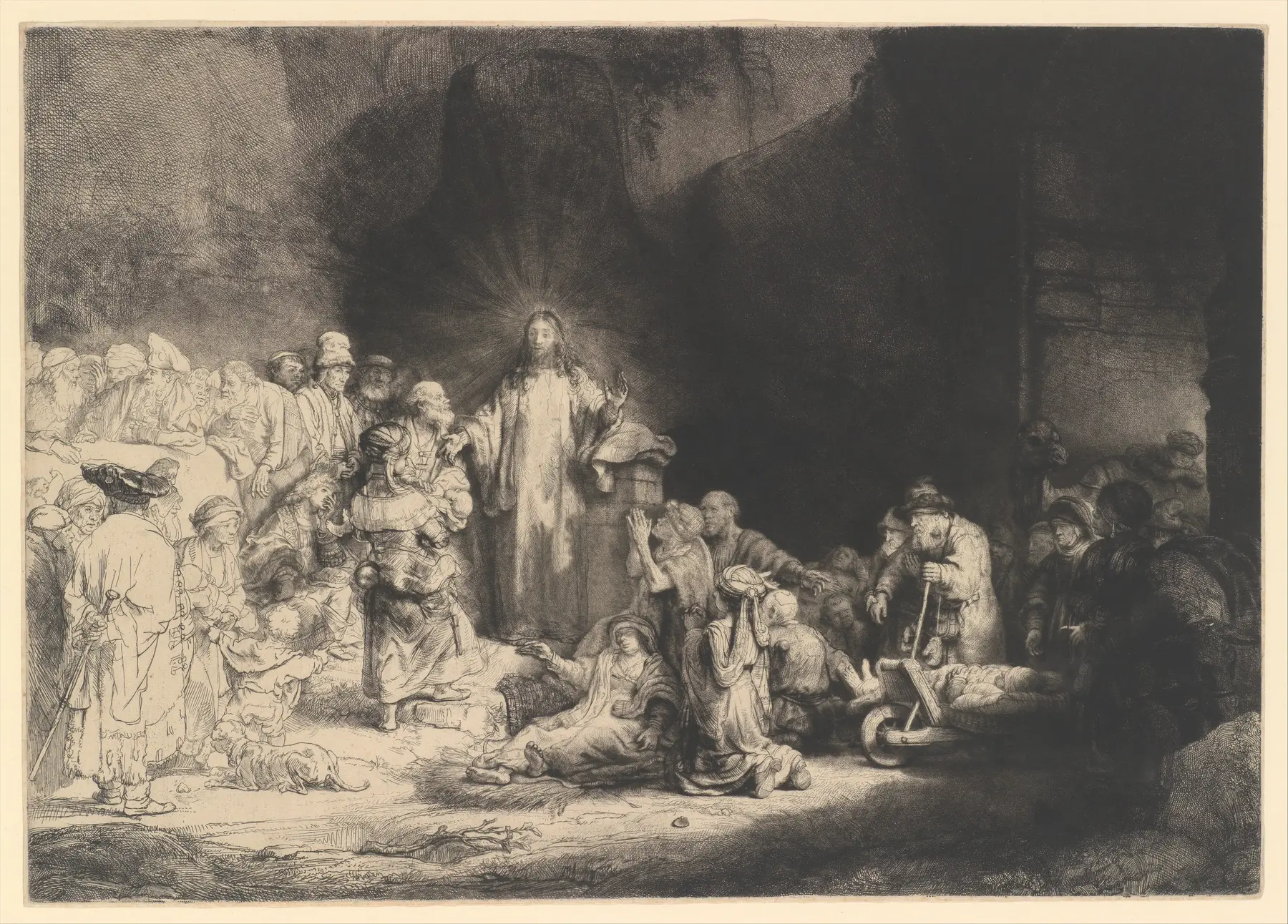
Rembrandt's The Hundred Guilder Print gathers almost the whole of Matthew 19 into one uneven company. Religious questioners lean toward Christ as parents bring children and sick and disabled people wait in the shadows. Nearby, a richly dressed young man sits with his hand to his face, and a camel stands at the edge of a crowd whose members do not appear to share age, health, status, or purpose.1
Christ occupies the light between them. Questions about marriage, children, healing, wealth, discipleship, and eternal life remain visible in the different bodies and gestures around him. The people belong to the scene because they have been drawn into relation with him.
A parish can become such a place. It can gather people whom modern life often places in separate schools, neighborhoods, workplaces, age groups, and digital worlds. Here strangers are given words to pray together, grace they did not earn, and neighbors whose presence cannot simply be filtered out.
The Worlds That Sort Us
Charles Taylor uses the term social imaginary for the shared background understanding that makes common practices and expectations seem possible. Every society carries such an imagination of belonging. It teaches which people naturally fit together and what they owe one another. This imagination is carried through institutions, habits, images, and stories before it becomes an argument.2
Much of modern life can make sorting easy. Markets can organize choice around preference, workplaces can teach people to value one another by usefulness and rank, and neighborhoods may hold people apart by price or distance. Political media and digital platforms can intensify the pattern by rewarding shared alarm while filtering out voices that disturb it.
A congregation can learn the same habits. Ministry may be designed around a preferred age, lifestyle, or family structure until familiarity begins to pass for communion. Music, dress, education, and political instinct can quietly establish the model against which every other Christian is measured.
Shared circumstances can give a congregation a necessary focus. Language congregations, culturally specific churches, campus ministries, military chapels, recovery groups, and communities formed under persecution may make Christian life possible where a general institution cannot. People wounded by churches may need spaces where they are understood without having to explain every injury. The problem begins when affinity becomes the church's account of communion and choice becomes the measure of belonging.
A People Received in Christ
The New Testament describes the church through gifts and relations that its members do not manufacture. Christ calls a people, the Spirit gives life and distributes gifts, and the Word addresses the whole assembly. Baptism joins believers to Christ's death and resurrection, while the Lord's Supper gives one bread to many members. Within this communion, the distinctions between Jew and gentile, enslaved and free, woman and man cannot determine a person's worth, access to Christ, or possession of the Spirit.
Christians disagree about how baptism and the Supper give or signify grace. Sacramental traditions speak of gifts through which Christ joins and feeds his people. Many Baptists call them ordinances, acts of obedience that confess Christ's saving work and gather a covenant community under his lordship. Churches in both streams can learn unchosen obligations through Scripture, prayer, testimony, discipline, service, and song.3
This unity does not make difference disappear. Paul's body has eyes, hands, feet, and members accorded different honor. Ephesians describes Christ making peace between peoples whose histories cannot be reduced to personality. The church becomes a household because strangers and aliens receive access to the Father through one Spirit.
John Chrysostom saw the social force of this claim. Preaching on Ephesians, he said that the Spirit unites people separated by race and custom, old and young, rich and poor, women and men. The claim remains a judgment upon any congregation that treats one class, culture, generation, or body as the model against which every other Christian is measured.4
A parish gives this theology an address. It asks a congregation to become the church in a particular place among actual homes, schools, shops, hospitals, care facilities, shelters, and streets. Pope Francis insists that the parish is not outdated because it can renew itself in contact with people's lives. He describes it as the church's presence in a territory, a community of communities ordered toward worship, growth, dialogue, charity, and mission. Without that renewal, he warns, it can become useless to its neighbors or self-absorbed among a chosen few.5
The warning belongs inside the definition. A boundary, a building, or an old name cannot accomplish this vocation. A parish becomes an alternative when Christ's gifts reshape who is welcomed, who is heard, and how power is used.
Communion Without Sameness
A congregation can gather people from different backgrounds and still require everyone to adopt the habits of its dominant class. It can use multilingual music, photographs, or festivals while leaving authority, money, preaching, and decision-making untouched. Representation matters, but communion asks who can act, speak, disagree, and be believed.
Catholicity means that a local church belongs to a people wider than itself. It does not require every congregation to display every human difference in miniature. A rural parish, a congregation serving migrants in their first language, and a house church meeting under danger will embody the one church differently. Each can remain oriented toward the whole body of Christ, open to gifts beyond itself, and unwilling to make local custom the measure of Christian humanity.
Doctrine matters within this account. The parish gathers around the triune name, the apostolic witness, the death and resurrection of Jesus, and the promise of his kingdom. These claims give the church grounds for challenging customs that diminish persons. They also prevent belonging from becoming a vague affirmation that asks nothing of anyone.
Grace creates a communion capable of repentance. Members may be asked to surrender prejudice, status, patterns of secrecy that shelter abuse, and the defensiveness that makes repentance difficult. Institutions may need to make restitution for resources unjustly acquired or withheld, confess harm, and accept oversight beyond the authority of an accused leader. Christian discipline belongs within this life, but it must serve reconciliation and remain answerable to Christ through truthful and accountable practices.
The Gift and Burden of Place
The territorial parish is a later Christian arrangement rather than a New Testament mandate. In Britain, its long development bound Christian presence to land, civic responsibility, and pastoral care, sometimes in oppressive forms. Congregational covenants, house churches, chapels, and other forms can also make love answerable in a place. No inherited model can simply be lifted from a village and imposed upon a mobile city, a university, a military base, or an online community.6
Andrew Rumsey calls parish a bond with place and describes its pastoral vocation as care for a particular people, land, and common life. He also recognizes its painful history of oppression and insularity. His account helps recover local responsibility without turning parish life into village nostalgia.6
Many people now belong to several places at once. A deployed service member prays with a chapel far from home, a student inhabits a campus for part of the year, and migrants sustain obligations across borders. Commuters may spend waking hours in one city and sleep in another, while digital friendship carries genuine care where physical community is thin. Parish theology should help these people name layered responsibilities as they seek to serve faithfully across those places.
The governing question is where Christian love becomes accountable. Who can ask something of the congregation, and who will notice whether it answers? A person may worship beyond the nearest boundary for sound reasons, yet a church still needs neighbors who can interrupt its plans and places whose welfare is not reducible to membership.
Place carries a theological gift because a congregation responsible to a neighborhood must learn to see beyond the people likely to join. The apartment building behind its parking lot, the worker waiting for a bus, the teenager with nowhere quiet to study, the elder aging alone, and the family whose language is not represented in worship all enter its field of attention. As they do, the church learns that these neighbors possess knowledge, leadership, and gifts it needs to receive.
This responsibility does not require every parish to meet every need. Small congregations can exhaust themselves under limitless moral demand, while clergy and volunteers become substitutes for public institutions that should provide health care, housing, education, and safety. A small congregation can begin by asking a neighborhood partner what it can reliably contribute. A commitment it can keep gives local responsibility a workable scale.
The same people return next Sunday carrying the old disagreement, the need for a ride, the restless child, the hymn sung more slowly than we prefer, and the conflict no meeting has resolved. Their return gives love a history and makes it more than affection for humanity at a safe distance.
Stability can become a discipline without becoming imprisonment. People may need to leave a congregation marked by abuse, retaliation, manipulated conscience, compelled disclosure, punishment for seeking outside help, or persistent danger. No theology of unchosen neighbors should bind the wounded to those who refuse accountability. Where safety permits, remaining long enough to know and be known can loosen the habit of abandoning every community that disappoints.
When the Parish Mirrors the World
Parish life carries no immunity from social sin. Wherever geographic boundaries reinforce racial or class exclusion, they require repentance and repair. Wealthy congregations can accumulate staff and programs while nearby churches struggle to keep buildings open. Historic architecture can delight the eye while remaining inaccessible to wheelchair users, people with hearing or sensory needs, and families without reliable transportation.
A language of family can make belonging sound intimate while concentrating power in a few households. Clergy then become gatekeepers of access, information, and favor, while longstanding members treat institutional memory as ownership. Newcomers may be welcomed as helpers without ever being trusted to change the community.
The Lord's Supper and the gathered assembly expose these failures. Paul tells the Corinthians that their divisions humiliate those who have nothing and contradict the meal they claim to celebrate. James condemns an assembly that gives the rich person the honored seat and tells the poor person to stand aside. Worship reveals whose body is honored and whose presence is merely tolerated.
Repair requires institutional practices that make responsibility visible. Reports of harm need a route outside the accused person's authority, with conflicts of interest disclosed, civil reporting duties honored, and no one compelled into reconciliation or secrecy. The same accountability should shape ordinary governance as congregations review access with disabled members, publish budgets in usable form, and give people affected by decisions a real part in making them. Neighborhood partners should likewise help define and evaluate shared work.
These practices help a congregation bring its structures into closer correspondence with the communion it receives in Christ. Grace frees a congregation to change its structures without mistaking institutional preservation for faithfulness.
A School of Common Life
In many liturgical parishes, people confess sins in the first person plural, hear Scripture through a common pattern, exchange peace with those standing nearby, carry neighborhood concerns into intercession, and receive bread with empty hands. Other congregations are formed through sustained biblical preaching, extemporaneous prayer, testimony, covenant, congregational song, mutual aid, and the Supper received as Christ's ordinance. In each form, repeated worship can train people to receive one another as gifts before they have chosen one another as friends.
Around these acts may grow less visible disciplines. A child grows among trusted adults who know her name and honor safeguarding boundaries, while a widower finds a table where his absence will be noticed. People divided by a real but bounded disagreement may prepare a funeral meal together, a professional receive instruction from a tradesperson, and a teenager read beside an elder. Through such encounters, people can practice belonging across the divisions that remain among them.
The parish also sends people outward. Members return to households, workplaces, schools, civic institutions, and public conflict carrying habits of attention learned in worship. The church serves the common good when it helps people recognize neighbors whom other systems render inconvenient or invisible.
A parish gathers a fragment of an unequal world around Christ and begins the patient work of truthful belonging. A neighbor may ask for a ride or question a closed meeting, making belonging particular. The congregation must answer that person, whose knowledge may expose something its members have failed to see.