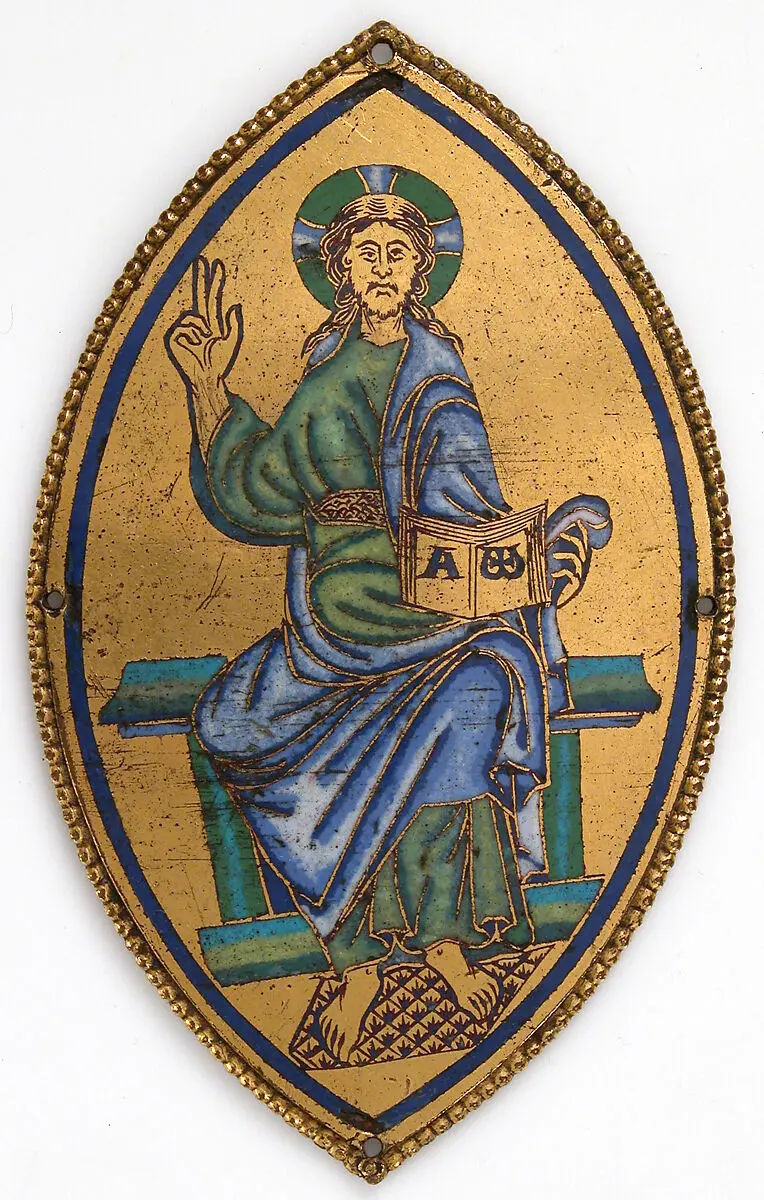
A small enamel plaque made in the Meuse Valley around 1160 presents Christ in Majesty within a field of blue and gold. He is seated, blessing, and holding the book. The image does not show a kingdom under construction. It shows the world already gathered beneath the reign of the risen Lord.
The plaque once belonged to the furniture of worship, perhaps an altar or pulpit. Its theology was therefore encountered in the repeated life of a congregation. Week after week, amid changing weather, harvest, work, illness, and household need, Christ remained enthroned. The ordinary passage of time took place before the same Lord.
American Protestants once gave part of that passage a name. Kingdomtide began as an ecumenical attempt to turn the long season after Pentecost toward the kingdom of God. It was never shared by the whole church, and later liturgical developments have largely fulfilled its original purpose. Yet the experiment preserved a pastoral insight worth receiving: long seasons have inner movements, and a modest change of emphasis can teach a congregation to notice them.
A Common Theme Before a Common Lectionary
Taylor Burton-Edwards, writing for United Methodist Discipleship Ministries, traces Kingdomtide's development and later decline. His account grounds the historical overview that follows.1
In the 1930s, Protestant churches in the United States often followed denominational lectionaries and program calendars. They agreed on Christmas, Easter, and the beginning of Advent, but the Sundays after Trinity or Pentecost lacked a broadly shared pattern. The Federal Council of Churches of Christ in America sought forms of cooperation that could give divided churches a common Christian focus.
A Presbyterian proposal supplied one answer. The Federal Council published it in a 1937 book on the church year under the name Kingdomtide. The initial plan designated the whole period between Trinity Sunday and Advent. Churches could retain their own readings while directing worship and preaching toward the reign of God.
The proposal changed quickly. A 1940 revision, influenced by the Methodist Church formed the year before, began Kingdomtide on the first Sunday of September and extended it to the end of the liturgical year. Methodists and Presbyterians became its principal advocates. The observance never became uniform, but it gave late summer and autumn a recognizable theological accent. Discipleship, vocation, stewardship, social holiness, mission, and the public claims of God's reign could be heard together.
Kingdomtide was therefore less a newly invented sacred season than a practical ecumenical agreement. Its creators did not need every church to adopt the same calendar at once because shared attention could begin with a common question: What does it mean to live under the reign announced and embodied by Jesus Christ?
That question resisted a merely inward religion. In the Gospels, the kingdom comes near in Christ's preaching, healing, table fellowship, forgiveness, and conflict with powers that diminish life. Jesus compares it to seed, yeast, treasure, a net, a banquet, and a landowner settling accounts. These images train attention upon hidden growth and final judgment, mercy received and lives made answerable to God.
Methodist worship still preserves something of this horizon. The Great Thanksgiving appointed for the season after Pentecost, Ordinary Time, or Kingdomtide remembers the prophets' hope for justice and peace, Christ's good news to the poor, his liberation of the oppressed, and the church's vocation for the world. The reign of God is confessed at the table as Christ's gift before it becomes a program of ecclesial usefulness.2
Why the Name Receded
The decline of Kingdomtide does not need to be narrated as spiritual loss. Its original ecumenical task was overtaken by a more substantial achievement. The Consultation on Common Texts brought Protestant and Catholic scholars and worship leaders into a shared process. It released the Common Lectionary for trial use in 1983 and the Revised Common Lectionary in 1992. Churches that once shared only a seasonal theme could now hear a wide scriptural sequence together.
The Revised Common Lectionary also distributes the kingdom teaching of Jesus throughout the year. No single stretch of Sundays must carry the entire subject. United Methodist resources retained the name, including in the title of a eucharistic prayer, while broad denominational support for a distinct season receded. Burton-Edwards therefore concludes that the common lectionary more fully accomplished the ecumenical purpose Kingdomtide once served.1
Related experiments continued elsewhere. The Church of England's resources for the period from All Saints to Advent invite reflection on the saints, the kingdom, judgment, and the hope of heaven and earth renewed.3 The Church in Wales appoints four Sundays of the Kingdom, beginning near All Saints and culminating in Christ the King.4 These later Anglican patterns are shorter than the American Kingdomtide and should not be treated as simple survivals. They carry a similar intuition. The final weeks of the year can acquire a distinct pressure without ceasing to belong to the season after Pentecost.
This is how a wise calendar works. It orders time firmly enough to form a people while acknowledging movement within a long season. Green remains green, and the appointed readings, collects, and feasts retain their authority, even as attention changes when the church approaches judgment, consummation, and Advent's promise of the coming Lord.
The Kingdom as Gift and Judgment
Any retrieval of Kingdomtide must also guard the word kingdom from becoming a religious name for whatever a church already wishes to accomplish. American Christians have often attached divine approval to national expansion, economic custom, social respectability, or partisan success. A season devoted to Christ's reign could intensify that error if the kingdom were treated as the church's possession.
The New Testament places the initiative in God. The Father gives the kingdom, the Son announces its nearness and embodies its mercy, and the Spirit creates a people who can receive it. Christian action matters because grace makes action possible and because neighbors need justice, truth, bread, protection, and peace. The church therefore acts as a witness to a reign that judges it along with every other power, never as the builder of a kingdom erected as a monument to its competence.
This is why the final movement of the church year holds hope and accountability together. Christ the King is the crucified one who identifies himself with the hungry, the stranger, the sick, and the imprisoned. His judgment exposes the distance between public confession and the actual treatment of vulnerable people. His kingdom also frees service from despair. The future does not depend upon proving that Christians can master history. It belongs to the Lamb who was slain and lives.
Kingdomtide's older emphases on social holiness, stewardship, mission, and vocation remain fruitful when they are ordered by this gospel. Stewardship then begins with gifts entrusted by God, social holiness grows from a communion created by mercy, and mission testifies to Christ rather than expanding an institution for its own sake. Vocation gathers these movements into the ordinary forms of love offered through paid work, unpaid care, citizenship, friendship, craft, and prayer.
A congregation turning toward the kingdom should therefore become more available to correction. It asks whose labor sustains its common life, whose suffering its habits overlook, and whether its worship opens into material care. Seasonal emphasis serves formation when it makes such questions harder to evade and the promise of Christ's mercy easier to hear.
The Weight of the Long Green Season
Ordinary Time is sometimes described as though little happens within it. In fact, ordinary life is where Christian formation does most of its patient work. The baptized learn fidelity through repeated Sundays, common meals, unfinished duties, forgiveness attempted again, and prayers said when no festival lends them emotional force.
Yet repetition is never flat. In much of the Northern Hemisphere, the long light of June yields bodily to the shorter evenings of September as schools reopen, household schedules tighten, football returns, and campfires and harvest foods reappear. Work regains a rhythm loosened by summer, and people feel the year changing through temperature, appetite, memory, family calendars, and the angle of evening light.
Kingdomtide gave that change a theological direction. The contracting day could turn thought toward the end of things, while harvest could recall both divine generosity and the biblical images of judgment. Renewed schedules then became an occasion to ask what orders a Christian life and to receive the return to ordinary labor as vocation under Christ's reign.
Such associations are local rather than universal. September brings spring in the Southern Hemisphere. School terms, agricultural cycles, sports, weather, and household customs vary widely. A church that mistakes the experience of one region for sacred time itself makes its own climate a measure of catholicity.
The Christian year gives a larger freedom. Its center is the history of salvation rather than the weather of any one country. Because Christ's birth, death, resurrection, ascension, and promised return order the year, local communities can bring their actual seasons into common prayer without requiring everyone else to inhabit the same landscape. Created time becomes an offering within the one history of grace.
Receiving September
Kingdomtide should not simply be restored because an older custom feels textured or beautiful. Retrieval becomes faithful when it serves the church's present obedience. The useful question is what this former observance can teach congregations that continue to follow their received calendars.
It can first teach attentiveness. Pastors know that people arrive at worship carrying the weeks they have actually lived. In September, that may include a child's first day of school, a teacher's exhaustion, a coach's responsibility, a farmer's anxiety, a worker's renewed travel, or a household trying to recover a sustainable rhythm. Intercession can name these realities. Preaching can recognize the forms of patience, justice, service, and stewardship they require. Parish meals and formation can make room for people whose schedules have changed.
The corporate response should remain restrained. A congregation need not replace appointed colors or overlay every service with regional nostalgia. Prayer for students, teachers, coaches, agricultural workers, and others whose work follows seasonal patterns may be enough. Where the lectionary permits, hymns can attend to creation, vocation, judgment, and hope, while fellowship may acknowledge the first cool evening or the local harvest. Such gestures deepen participation in the inherited calendar by helping worshipers bring their embodied lives to it.
Households have wider freedom to receive September through a renewed rule of prayer after summer travel, a weekly meal with neighbors, a blessing for a school year, a walk taken with gratitude, or a deliberate return to neglected work. These practices do not make the season holy by private invention. They receive created time as gift and place it beneath the reign of Christ.
The deeper wisdom of Kingdomtide lies in this modesty. The church does not need a new brand for every transition, only enough attention to recognize that repeated time is still moving toward God's promised future. Common prayer holds the year together, while local accents help particular people hear where they stand within it.
Time Beneath the Reign of Christ
The enamel Christ from the twelfth century offers the right final measure. His reign is neither a mood created by autumn nor a theme confined to several Sundays. The book rests in his hand. His blessing extends beyond the frame. Worshipers pass through seasons before the one whose kingdom has come near and whose appearing they await.
Kingdomtide once helped divided churches face that Lord together. Its ecumenical task changed when a common lectionary gave them a richer form of shared hearing. Its pastoral task remains. The church may receive the subtle turns within ordinary time and allow them to deepen prayer, vocation, judgment, gratitude, and hope.
September need not become a universal sacred season in order to become more visible. As a congregation notices the lives gathered in its pews and a household receives changing routines with intention, the long green season leans quietly toward its end. Within every change, Christ remains the Lord who gathers created time into his kingdom and prepares the world for its promised renewal.