Ichabod Crane enters Tim Burton's Sleepy Hollow by coach, consulting his commission papers as the carriage travels through the woods. He has been sent to investigate killings that the villagers attribute to a headless rider. He passes from official papers into a crowded house, where the village's leading men receive him.1
When the leaders offer the Headless Horseman as their answer, Ichabod begins with what can be examined. He disputes their explanation, studies a hoofprint, directs an exhumation, and works with the village physician. The sequence is sometimes grotesque, but its governing action is attention. He lets evidence from the bodies and the ground correct the living's assumptions.1
Later, frightened villagers crowd the church while the Horseman remains outside. He does not enter, though Baltus is seen at a window with a fence post through him, and further violence breaks out among the people inside. The scene gives fear a limit without making the shelter absolute or the sheltered people peaceful. The boundary keeps the Horseman outside while violence still reaches through the window and panic continues within.2
The church scene expresses a recognizable longing for a place where, when death comes near, a body may be carried, a name spoken, and fear held within prayer. The film gives that longing an image. Christian teaching about hallowed ground comes from the church's prayer at burial.
What the Ground Can Hold
In the Prayer Book burial office, Christian burial begins with a promise received before the mourners can find words of their own. The rite opens with Christ's words, “I am Resurrection and I am Life, says the Lord.” The sentence does not make grief less bodily. Mourners stand before a body or ashes while an empty place remains at the table, having carried the dead as far as human hands can carry them. Christ's promise is spoken within that loss and gives the mourners words when their own have grown thin.3
The office remembers God's mercy, commends the departed, comforts those who mourn, and commits the body to the ground in the hope of resurrection. The earth cannot save the dead. The committal treats the body with reverence because Christ promises to raise it. Paul names Christ as the first fruits of those who have died and looks toward the day when death itself will be destroyed.34
To hallow a place is to set it apart through prayer for sacred use. In Church of England practice, a church or burial ground may be consecrated and placed under a bishop's oversight. Roman Catholic teaching likewise includes the blessing of places among the church's sacramentals, the prayers and signs by which the church prepares people to receive grace. In that account, their fruit lies in the church's intercession, not in an impersonal force lodged in an object or plot of soil.56
Reformed and Baptist traditions speak of place through different theological claims. The Westminster Confession says that worship under the gospel is not tied to any one place or made more acceptable because of where it occurs. Baptist confession locates the church among people joined by covenant under Christ's lordship and rests final hope in the resurrection of the dead. These accounts can support faithful care for a dedicated building or burial place without claiming that prayer changes the soil's sacred status.78
These traditions disagree about what the church's prayer does to a place. They differ over whether setting ground apart gives it a distinct theological status. These accounts need not imply that prayer in one place is more acceptable to God than prayer elsewhere. Jesus turns rivalry over holy sites toward the Father in spirit and truth, while the apostles describe the people joined to Christ as God's dwelling and a living temple.9
A burial ground can still bear a serious public witness. Here bodies are not refuse. That witness becomes credible as names are preserved, graves are tended, and mourners are accompanied. Those who hallow or dedicate such a place undertake a responsibility to remember truthfully. The prayer does not guarantee that they will fulfill it.
Refuge Answerable to Truth
A churchyard may offer quiet when grief has made ordinary rooms unbearable. A church may open its doors when neighbors are frightened. Its people may keep vigil, bring food, and make room for lament that has no quick conclusion. Such refuge is a gift. Because a place set apart for truthful memory is entrusted to human keepers, its witness is tested by how they respond when the truth concerns harm within the church itself.
For a person harmed by clergy or congregation, a church building may carry danger rather than refuge. No account of sanctuary should demand a return to the place of injury or treat reluctance as spiritual failure. Care may need to begin elsewhere, under other authority, with choices controlled by the wounded person.
The integrity of a sacred place is tested when someone reports harm connected to the church. Care begins by recognizing that the report deserves an honest hearing and prompt attention to safety. A parish cannot answer only by lighting a candle or promising prayer. As a pastoral minimum, this essay proposes protecting anyone at immediate risk, securing relevant records, following the law and safeguarding policy that apply, keeping the response outside the accused person's control, and seeking competent independent help. No one should be coerced into forgiveness, secrecy, or renewed contact. This proposal does not replace applicable law, policy, or professional guidance.
Prayer and investigation can serve the same refusal of abandonment, though they do different things. Prayer places what happened before the God who judges truthfully and shows mercy, while investigation attends to testimony, evidence, responsibility, and protection. The church needs both if holy language is not to become a cover for fear.
This is where the film's boundary must be read with care. The sequence states and dramatizes a line the Horseman does not cross, but that restraint is not yet reconciliation. People stand within a place of refuge while fear and concealed wrongdoing remain among them.2
The later revelation makes the distinction sharper. Lady Van Tassel recounts the dispossession that shaped her grievance and the human scheme that followed. She says that she brought village leaders, including the Reverend Steenwyck, under her power. Katrina asks whether her stepmother killed her own sister. Injury helps explain the revenge, but it does not excuse it. The terror has been directed by human calculation and sustained through compromised authority.10
Discovering that the Horseman is real does not make patient investigation a mistake. Inquiry can test rumor, attend to evidence, and make responsibility visible. It cannot make death harmless or place every loss within human mastery. Faith welcomes every truth patient inquiry uncovers while entrusting even death to the promise of Christ.
The Company That Death Cannot Dissolve
In Episcopal usage, All Hallows' Eve falls on October 31, the eve of All Saints' Day on November 1. The optional Commemoration of All Faithful Departed appears on November 2 and is also known as All Souls' Day. The observances are connected, but distinct. They do not settle every question about popular Halloween customs. Their place in this essay turns attention toward God's grace in the saints, the memory of the dead, and the resurrection of the body.11
The communion of saints is more than a gallery of admirable figures from the past. It is communion in Christ. Christians disagree about prayer for the departed and asking the saints' intercession. Across these differences, many traditions still confess that the church belongs to a company wider than the people visible in one room and that death does not cancel Christ's claim upon his people. Hebrews addresses Christians as those who have come to Jesus the mediator amid the heavenly assembly. First Corinthians centers final hope on the resurrection of the body, while Revelation looks toward creation made new.12
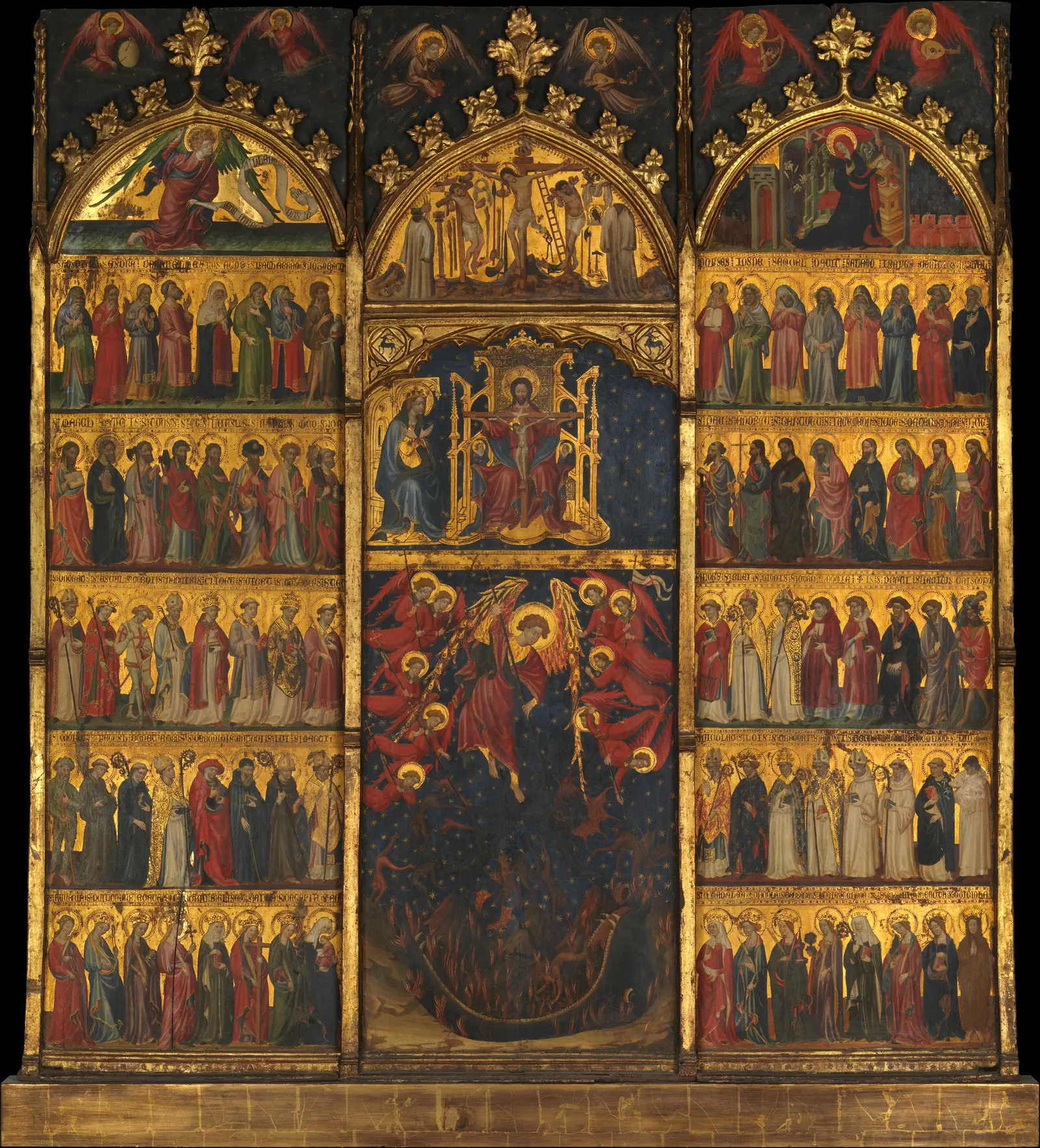
The artwork accompanying this essay was made for a burial chapel around the year 1400. In The Trinity Adored by All Saints, ranks of saints turn toward the Father, Son, and Holy Spirit. Saint Michael and other angels drive rebel spirits downward beneath the gathering. Its gift is a different direction of sight. The saints are gathered toward God, while conflict lies under divine judgment.13
This is the deeper answer to the churchyard's boundary. Christian hope does not rest on a protected enclosure that death cannot enter. Christians bury within the knowledge that death reaches every community and that Christ himself entered the grave. The risen one gathers his people beyond the reach of any wall. In the Prayer Book rite, the ground receives the body for a time. The departed are commended to God's keeping, and Scripture promises that Christ will raise the dead.34
Leaving the Churchyard
At the film's close, the survivors travel by carriage from the woods to New York's crowded streets. Read as an ending rather than an argument, the journey returns the survivors to a shared world.14
At the grave, the Prayer Book office names the dead, commits the body to the ground, and asks God to keep what human hands cannot keep. When the office ends, the living return to their neighbors carrying grief, testimony that must be heard, and wrongs that still require repair. The promises spoken there teach them to undertake this work in the presence of God.3
Jesus Christ has the last word over the grave and every fear gathered around it. He was buried and rose, and he will raise his people in a creation made new.412